
Introduction — why web design matters for UK solicitors
A professional website is more than an online brochure for solicitors. Good website design for law firms uk builds trust, supports client acquisition and helps you meet regulatory obligations. This guide explains the features solicitors should prioritise, covers compliance and technical basics, and ends with a practical checklist you can use to brief a redesign or audit a current site.
It is written for partners, practice managers and marketing leads at small or growing UK law firms comparing agencies or planning a redesign.
What law firms need from their website (quick summary)
Primary business goals: enquiries, appointments, referrals
Most firms need the website to generate instructing enquiries, encourage appointments and support referral relationships. Clear service pages, visible contact routes and a professional tone are essential.
Secondary goals: reputation, resources and recruitment
Websites also act as an archive of firm expertise: client resources, thought-leadership articles and recruitment information that reinforce reputation and support growth over time.
website design for law firms uk — core design and content features
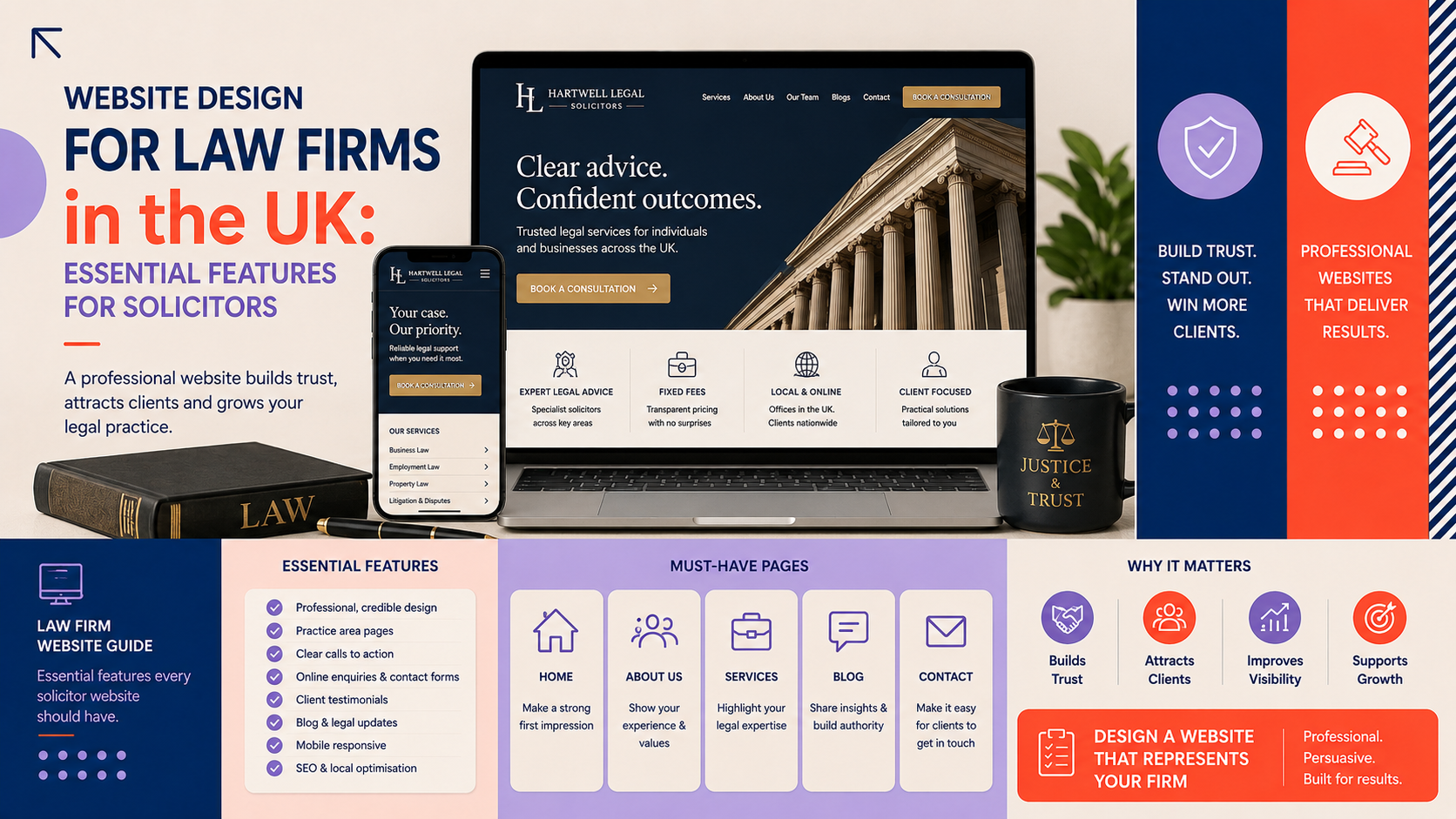
The following are practical, must-have elements for effective solicitor website design.
Clear services and specialist pages — how to structure practice areas
Group practice areas into logical sections (for example: Family, Employment, Commercial, Property). Each specialist page should explain who the service is for, typical outcomes, process steps and clear next steps to contact the firm. Avoid legal jargon: write for clients.
Strong, readable homepage and hero messaging — converting visitors quickly
Your homepage should answer three questions within a short scan: who you are, what you do and how a visitor contacts you. Use a concise hero message and an immediate call to action. Visual hierarchy and short sentences help visitors find this information quickly.
Prominent contact and conversion points — contact forms, click-to-call, booking
Make contact options visible on every page: phone, email and a short enquiry form. Consider click-to-call for mobile visitors and an online booking tool if you offer consultations. Keep forms short and purpose-built to reduce friction.
Trust signals and credentials — SRA, Law Society, qualifications and case studies
Display relevant credentials such as SRA membership numbers, Law Society accreditation where appropriate and representative case studies (observing confidentiality). Trust signals should be easy to find and verifiable.
Team pages and lawyer biographies — what to include for credibility
Avoid single-line bios. Include role, experience, qualifications, regulated status, areas of expertise and a professional photo. Add contact details and links to relevant practice pages. Short video introductions can help but are not required.
Content strategy for solicitors — articles, FAQs and local pages
Maintain a schedule of useful articles and FAQs that answer client questions rather than provide legal advice. Localised pages help firms attract searches for nearby services. Useful content supports enquiries and reduces repetitive calls.
Accessibility and equality
Legal services must be accessible. Implement clear headings, readable fonts, sufficient contrast and keyboard navigation. Responsive layouts are part of this approach — for more on mobile-first agency guidance see our article on responsive web design for small business. Also consider providing documents in alternative formats on request.
Privacy, cookies and GDPR
Include a clear privacy notice, cookie banner and information on how you process client enquiries. Avoid publishing client-identifying material without consent. For regulatory clarity, seek guidance from the SRA or a data-protection specialist before publishing complex policies.
Technical performance and security
Technical choices affect user experience and trust. Prioritise secure hosting, fast page loads and regular maintenance.
Mobile responsiveness and why it’s essential
Most users will visit on mobile. A mobile-first approach ensures content and contact routes work on small screens. See our guidance on responsive web design for small business for practical steps.
Page speed and performance basics
Optimise images, enable caching and use a content delivery network if appropriate. Faster pages improve user satisfaction and reduce drop-off for people seeking advice.
Security and data protection: TLS, backups and plugins
Always use TLS (HTTPS), keep automated backups and restrict access to client data. Vet third-party plugins for security and only install essential extensions. Maintain a tested restoration process so you can recover quickly if something goes wrong.
Recommended CMS and maintainability
WordPress is a common choice for small and growing firms because it balances flexibility with manageability. For help preparing and maintaining a WordPress site see our WordPress website design checklist for UK small businesses, which covers setup and update routines.
Design, branding and tone for law firms
Your design should communicate professionalism while remaining distinct from competitors.
Professional but distinct branding — logo and visual identity
A clear logo and consistent visual identity support recognition. Avoid bland templates that make firms look identical. For firms needing a new identity, our Custom Logo Design service and our article on logo design for law firms UK: how to build trust without looking generic explain practical choices for legal practices.
Imagery and photography guidance — avoiding clichés
Use authentic photography of your office and people where possible. If you use stock images, choose natural, diverse visuals that reflect your firm’s character and client base. Avoid overly staged legal clichés.
Readability and layout for legal content
Use short paragraphs, clear headings, bullet lists and emphasised summaries for longer pieces of content. This helps clients scan and understand important information quickly.
Conversion optimisation and client journey
Design with the client journey in mind: find, understand, contact and convert.
Designing easy contact routes
Place contact options in the header and footer, and include contextual CTAs within service pages. For urgent matters, highlight emergency contact routes where appropriate.
Forms, calls and appointment booking
Keep forms short and explain why you need each data field. Use click-to-call on mobile and consider an appointment tool that integrates with your calendar for straightforward booking.
Tracking and analytics basics
Install analytics to measure enquiries, popular pages and bounce rates. Track form submissions as goals and use anonymised behaviour data to improve content and navigation.
Content governance, compliance and ongoing maintenance
Legal content must be accurate and up to date. Establish routines for review and clear responsibilities.
Review schedule for legal content
- Set a regular review cadence for practice pages (for example every 6–12 months).
- Flag time-sensitive content such as changes in law or fee structures for immediate review.
Roles: who owns web content in a firm
Assign a content owner (partner or marketing lead) and an editor responsible for publication. Keep a simple approvals workflow to ensure accuracy and regulatory compliance.
Plugin and platform update policies
Schedule and test updates in a staging environment before applying them to the live site. Maintain a documented backup and rollback plan.
Options comparison: DIY, templates or agency build
Choose the delivery route that matches your budget, technical resources and risk appetite.
Template websites and pros/cons
Templates are cost-effective and fast. They can work well for firms on a budget but risk looking generic and may need technical adjustments for accessibility or compliance. If you plan to sell documents or fixed-fee products, consider platforms we work with such as E-commerce Store Design or Shopify Web Design as examples of supported project types.
DIY with page-builders
DIY solutions give control and can be economical, but they require someone to manage updates, security and content governance. They are most suitable where internal staff can commit to maintenance tasks.
Agency builds and what to expect
An agency build costs more but provides strategic input, customisation and ongoing support. For B2B-focused firms our B2B Web Design service is relevant when you want a site tailored to professional clients and referral partners.
Practical checklist: briefing a web project for solicitors
Use this checklist when briefing an agency or auditing your current site.
Technical checklist (hosting, SSL, backups, speed)
- Secure hosting and automatic TLS (HTTPS).
- Daily or at least weekly backups and a tested restore process.
- Optimised images, caching and acceptable page-speed metrics.
Content checklist (services, team pages, policies)
- Dedicated pages for each practice area with clear calls to action.
- Complete team bios with qualifications and contact details.
- Privacy notice, cookie policy and complaint procedures.
Design checklist (branding, imagery, responsiveness)
- Distinct logo and consistent colour palette.
- Professional photography or suitable stock imagery.
- Responsive layouts tested on common devices.
Compliance checklist (GDPR, accessibility, disclosure)
- Clear consent for cookies and tracking tools.
- Accessibility improvements for contrast, headings and keyboard navigation.
- Regulatory disclosures and SRA information where required.
How Logo Metic can help
Logo Metic delivers WordPress builds and design services suited to small law firms and solicitors. Our WordPress Web Design offering can be tailored for solicitor requirements including accessible templates, secure hosting recommendations and content governance support. See our WordPress Web Design page for details.
We also offer branding work and logo design to help firms stand out; learn more on our Custom Logo Design page.
Requesting a consultation will provide a practical next step: an initial review of your site, an outline scope and a recommended approach without obligation.
Next steps and closing summary
Quick self-assessment actions: review your homepage for an immediate call to action, confirm SRA and privacy disclosures are visible, and check your site on a mobile device for readability.
If you would like help, Request a free consultation with Logo Metic to discuss your law firm website and we can review your needs and suggest options that suit your firm’s size and budget. Contact us at support@logometic.co.uk or call +44 7883 180004.
Frequently asked questions
Do law firms in the UK need to meet specific accessibility standards on their website?
There is no single law that prescribes a checklist for all websites, but public sector bodies must follow formal WCAG standards and private firms are expected to take reasonable steps to make services accessible. Firms should treat accessibility seriously and seek advice to meet common WCAG checkpoints.
Is WordPress secure enough for a solicitor firm and client data?
Yes, WordPress can be secure when hosted correctly, kept up to date and managed with strong access controls and vetted plugins. For sensitive client data consider additional protections and discuss your requirements with a specialist.
What essential pages should a solicitor website include to build trust?
At minimum: a clear homepage, detailed practice area pages, full team bios, contact page with phone and address, privacy and cookie information and regulatory disclosures such as SRA details.
How should a law firm handle GDPR and privacy notices on its website?
Provide a clear privacy notice explaining what personal data you collect, why you collect it and how long it is retained. Use a cookie banner for tracking cookies and obtain consent where required. For detailed obligations consult the ICO or a data-protection adviser.
How long does a professional website build typically take for a small law firm?
Timelines vary by scope. A simple template-based site can be delivered in a few weeks, while a bespoke build with content work and compliance checks can take several months. Discuss timelines up front with any supplier.
If you need tailored help, Request a free consultation with Logo Metic to discuss your law firm website and we will outline a clear next step for your practice.