Introduction — why lead magnets and landing pages matter for UK professional firms
Lead magnets are a cost-effective way for accountants and solicitors to qualify enquiries, demonstrate expertise and measure ROI. For UK professional firms, a well-designed downloadable or gated resource paired with a dedicated landing page can reduce unqualified calls and speed up the path to an instructing conversation.
This guide explains which lead magnets work for professional services, practical design and copy tips, landing-page structure, three ready-to-adapt templates, promotion tactics and a launch checklist. It emphasises compliance, data protection and reputation management so partners and practice managers can act confidently.
What this guide covers and who should use it
Use this guide if you are a partner, practice manager or marketing lead at a UK accountancy or law firm who needs practical lead-generation content. You’ll get examples tailored to accountants and solicitors, copy swipes you can paste into a landing page, and the technical checks to launch safely.
Primary risks for professional firms (compliance, data protection, reputation)
Before publishing, check relevant professional rules and client-confidentiality requirements. You must also present clear GDPR-compliant consent for marketing and protect any personal data captured. Where content provides legal, tax or financial guidance, include careful wording and advise readers to seek bespoke advice.
lead magnets b2b professional services uk — which lead magnets work
Different magnets suit different funnel stages. Choose one that matches the buyer’s decision stage and the time your audience will spend engaging.
- Checklist and quick guides — short, practical items that save time. Example for accountants: a “Year-end accounts checklist” that a finance director can use in 10–15 minutes.
- Calculators and self-assessment tools — interactive tools such as an “IR35 readiness quiz” or a downloadable cashflow forecast template. These qualify traffic by revealing a user’s status or urgency.
- Short templates and letter packs — for solicitors, an onboarding letter template or contract checklist; for accountants, a client onboarding pack. These show practical competence and are easy to brand.
- Industry-specific reports and whitepapers — use when you can offer unique insight or data. Longer and more resource-intensive, these are best reserved for targeted campaigns to senior decision-makers.
- Webinars, clinics and on-demand video — useful for more complex topics and for live qualification. Recordings can be gated afterwards for ongoing capture.
Match the complexity of the lead magnet to the value of a converted lead: quick checklists are great for volume; whitepapers and webinars are better for high-value, niche work.
Design principles for high-converting lead magnets
Value-first: promise, outcome and time-to-complete
State clearly what the reader will get, the outcome and how long it takes. Example: “Complete our 10-point year-end checklist in 15 minutes to reduce filing errors.”
Format and length guidance
Keep checklists to one page or a short PDF. Templates and letter packs should be editable (Word or Google Docs). Whitepapers should include an executive summary and clear chapter headings for skimming.
Branding and trust signals
Use sober, professional branding: clear logo, firm name, a short author bio and regulated status where applicable. If you need a refreshed identity for lead materials, consider a professional mark designed to build credibility; Logo Metic offers Custom logo design to help with that step.
Accessibility and mobile-first design
Design PDFs and pages for mobile viewing. Use readable fonts, short paragraphs and accessible colours. Provide plain-text alternatives where possible so busy decision-makers can consume content on any device.
Landing-page structure and copy that converts
A landing page for a professional lead magnet must combine clarity, compliance and friction-free capture.
Headline, subhead and one-sentence value proposition
Headline: clear and benefit-led. Subhead: adds context. One-sentence value prop: explains who the guide is for and the outcome.
Hero section: what to include
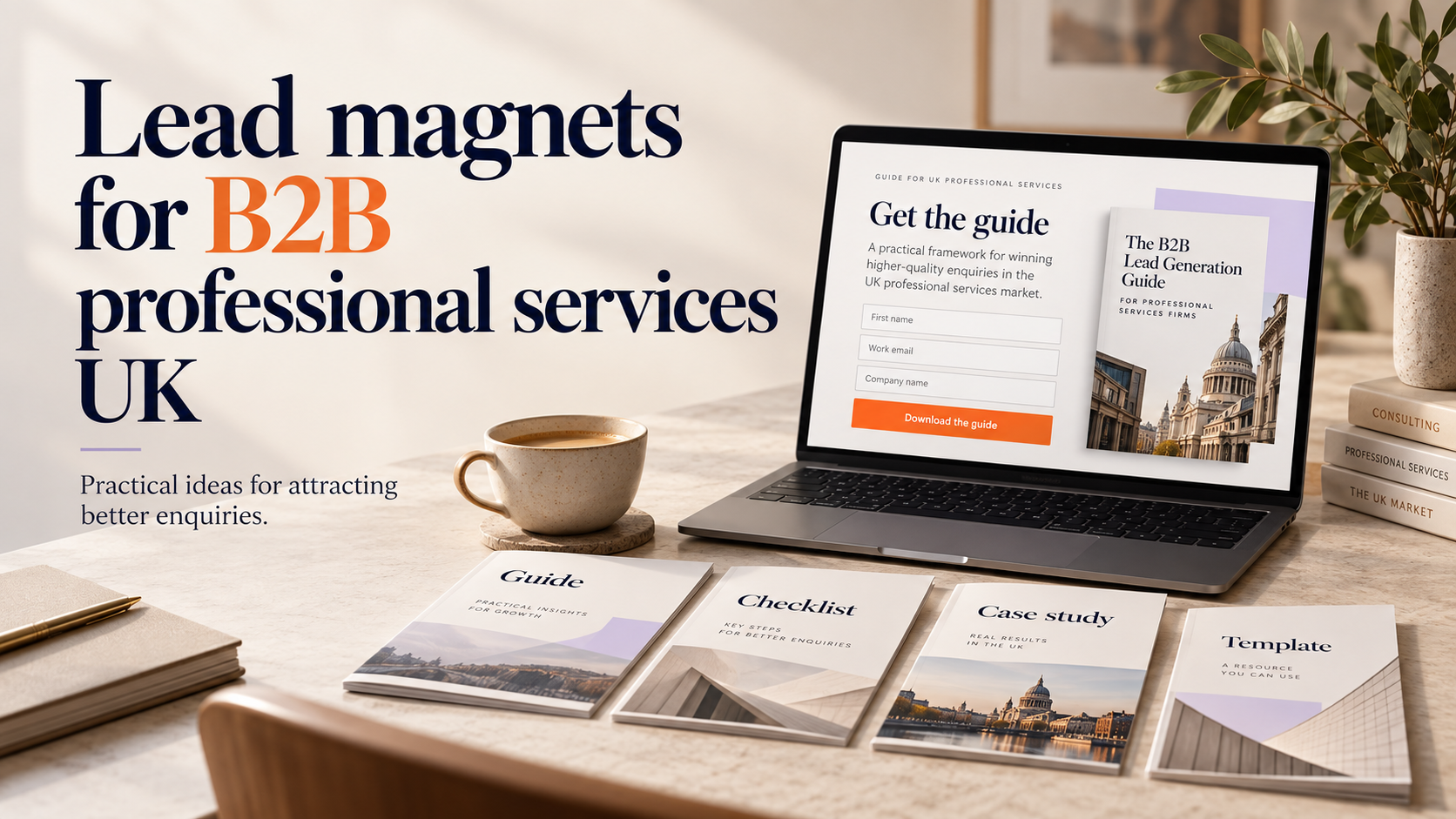
Include a short visual or icon, a 2–3 field short form and a primary CTA. Avoid excessive imagery that distracts from the conversion goal.
Trust and proof
Use client logos (with permission), regulated status, professional memberships and a short testimonial or case example. For solicitor landing pages, the existing Logo Metic article on landing page design for solicitors (UK) gives further guidance on compliant messaging and conversion checklists.
Lead form design and GDPR-compliant consent
Ask only for what you need. Typical fields: name, business email, job title and company. For higher-value offers you can add phone and optional notes. Include concise consent text specifying the lawful basis (e.g. legitimate interests or consent) and link to your privacy notice. Example consent line: “I consent to receive relevant communications from [Firm] and understand how my data will be used — see privacy notice.” Always keep records of consent and allow easy opt-out.
Above-the-fold vs below-the-fold balance
Keep the hero conversion element prominent. Use below-the-fold space for short benefit bullets, a brief author bio, and a clear privacy note.
Mobile, speed and accessibility considerations
Ensure fast load times, compressed images and an accessible form. If you need technical help to launch a responsive landing page quickly, Logo Metic’s Responsive web design services can help improve cross-device performance.
Three ready-to-adapt landing page templates (copy swipes)
Template A — Accountant: ‘Free year-end checklist’
Headline: Complete your year-end accounts checklist in 15 minutes
Subhead: A one-page checklist for company secretaries and finance teams to avoid common filing mistakes.
Benefits (bullets):
- Step-by-step tasks for accounts preparation
- Common errors and how to avoid them
- Quick links to further support
Form fields: Name, Business email, Company, Job title — Download now.
Follow-up: Automated email with the PDF and an invitation to book a 15-minute review call. For more on capturing leads across your homepage, see our article on designing a lead-capture homepage for accountants (UK).
Template B — Solicitor: ‘Quick legal health-check’
Headline: Free 5-minute legal health-check for growing businesses
Subhead: Rapid checklist to highlight key legal risks and next steps.
Trust elements: Regulated status, short partner bio, and a note on client confidentiality.
Form fields: Name, Business email, Company sector, Phone (optional).
Follow-up: Email with bespoke guidance and an invite to a 20-minute clinic. For more on compliant landing pages for lawyers, consult our landing page design for solicitors (UK) guidance.
Template C — B2B adviser: ’30-minute risk assessment’
Headline: Book a 30-minute risk assessment (free for new prospects)
Subhead: A short call to review immediate risks and recommend next steps.
Form fields: Name, Business email, Company, Preferred call times (select). Include calendar link guidance (embed a Calendly or similar).
Follow-up: Confirmation email with a brief pre-call questionnaire to improve qualification.
Distribution and promotion strategy for maximum reach
Organic channels
Promote the magnet on your website, relevant blog posts, LinkedIn company page and partner profiles. Use short posts that point to the landing page and include a clear CTA.
Paid channels
LinkedIn Sponsored Content can target decision-makers by role and industry. Google Ads can support intent-led searches for specific problems. If you plan to sell downloadable templates or paid guides from the landing page, you may need e-commerce functionality; consider E-commerce web design or a storefront via Shopify web design depending on scale.
Referral and partner routes
Use professional networks, local chambers and trusted introducers. A short partner briefing note explaining the magnet and referral process increases uptake.
Using gated content responsibly
Gate content when it has strong exclusive value or when you need to qualify leads. Ungated summaries or an executive summary often help with organic reach while gating the full resource.
Measuring success and optimisation checklist
Key metrics to track
- Landing-page conversion rate (visitors to leads)
- Cost-per-lead for paid campaigns
- Lead qualification rate (percentage of leads meeting your criteria)
- Follow-up conversion (leads to meetings or instructions)
Simple A/B tests to run first
- Headline variations
- CTA text and button colour
- Form length: short vs slightly longer
- Hero image vs minimal hero
Follow-up workflow suggestions
Automate an immediate email with the resource, then a short sequence: Day 2 (value add), Day 7 (invite to book), Day 14 (case study). Track engagement and route qualified responses to client-facing staff within 24–48 hours.
Launch checklist — ready to publish
- Legal and data checks — confirm professional marketing rules and privacy notice wording; ensure clear consent text and lawful basis for processing.
- Design and UX checks — test on mobile, check load times and make sure the form works across browsers.
- Analytics and tracking — add goals, UTM parameters, and event tracking for form submissions.
- Post-launch tasks — enable the follow-up email sequence, confirm lead routing and set a review date for data and performance.
Next steps and how Logo Metic can help
When to get external help
If you need a rapid, editable landing page build on WordPress, assistance with design assets or conversion optimisation, external support can speed delivery and reduce risk. Request a WordPress web design consultation to discuss options and timelines.
Suggested starting package: landing page + lead magnet design
A typical starter package includes the lead magnet PDF or template, landing-page design and a short follow-up email sequence. For firms needing sector-specific UX and messaging, see our B2B web design services.
FAQ
What types of lead magnets work best for accountants in the UK?
Short checklists, year-end guidance, cashflow templates and client onboarding packs work well. They should be quick to use and clearly branded.
How do I make a landing page GDPR-compliant for lead capture?
Collect only necessary data, include a concise consent statement with a link to your privacy notice, and record lawful basis for processing. Keep opt-out straightforward.
What form fields should solicitors ask for on a lead magnet landing page?
Start with name, business email, company/organisation and a brief description of the issue. Offer phone as optional. Avoid capturing sensitive case details on the form.
How quickly should my firm follow up on leads captured by a lead magnet?
A confirmed lead should receive an automated resource email immediately and a personal follow-up within 24–48 hours for qualification.
Can I use the same lead magnet across LinkedIn and my website, or should I adapt it?
You can use the same core magnet, but adapt the landing page copy and ad creative to match the audience and entry point. LinkedIn audiences may prefer more direct calls-to-action aimed at decision-makers.
Request a free consultation with Logo Metic — if you want help designing a compliant lead magnet and building a high-converting landing page, request a WordPress web design consultation with Logo Metic to discuss your project.