

If you sell locally or nationally and are exploring ecommerce website design Birmingham, this guide will help you decide whether to build or commission a new store, compare platform and agency options, and follow a practical checklist for briefing and launching your online shop.
Why this guide matters for Birmingham retailers
Who this guide is for
This article is aimed at small retailers, startups and growing local brands in Birmingham who sell products or services online. It is practical rather than technical: use it to scope a project, brief an agency or plan a DIY build.
What you’ll learn
We cover platform choices, design and UX essentials, payments and shipping considerations specific to Birmingham sellers, SEO and conversion optimisation, and a concrete asset checklist to prepare before briefing an agency.
Local considerations for Birmingham sellers
- Define delivery zones early — Birmingham suburbs and neighbouring towns affect courier choice and costs.
- Think about click & collect from a city centre location or local depot.
- Local marketing (Google Business Profile, city landing pages, local social ads) can reduce acquisition costs while you build brand recognition.
Do you need a new ecommerce website or improvements to an existing store?
Signs you need a rebuild vs a redesign
- Rebuild: poor site performance, legacy platform with no modern integrations, or architecture that prevents scaling inventory or orders.
- Redesign: outdated look and low conversion despite healthy traffic; you can keep the platform but improve UX and templates.
When to migrate platforms (growth, performance, integrations)
Consider migrating when your current platform cannot support necessary integrations (stock control, accounting, multi-channel selling) or causes repeated performance issues. If you sell B2B or need complex price lists and purchase orders, look at specialised workflows — Logo Metic’s B2B web design service can help compare those options.
Quick fixes that can reduce abandonment
- Improve page speeds: compress images, enable caching and select a lightweight theme.
- Fix broken checkout fields and offer guest checkout.
- Show clear delivery information and expected lead times on product pages.
Choosing the right platform and build approach
Hosted ecommerce (Shopify) — when it’s suitable
Shopify suits retailers who want a managed service with simple hosting, built-in payments and app integrations. It’s often faster to launch and easier to maintain for smaller teams. If you prefer a hosted route, see our Shopify web design service for typical projects and considerations.
Self-hosted (WordPress + WooCommerce) — when it’s suitable
WordPress with WooCommerce is a strong choice for stores that need content-led marketing, custom product pages, or tight editorial control. It’s flexible and cost-effective for growing businesses prepared to manage hosting and updates. For help with this approach, view our WordPress web design service.
Custom builds and marketplaces — pros and trade-offs
Custom builds offer full control but increase costs and ongoing maintenance. Marketplaces and multi-channel selling can be part of your strategy, but they do not replace having your own brand-owned storefront.
How to choose based on product range and integrations
- Small catalogue (under 100 SKUs): Shopify or WooCommerce both work well.
- Large catalogue or complex variants: prefer platforms that support robust inventory and filterable categories.
- If you need specific integrations (EPOS, Xero, bespoke stock systems), confirm connector availability before deciding.
If you’re considering agency support for an ecommerce project, our E-commerce store design page explains the typical build approach and deliverables.
Design and user experience essentials for ecommerce
Clear value proposition and homepage hierarchy
State what makes your store different — faster delivery in Birmingham, locally-made products, or unique warranties — and present primary CTAs prominently. Use a clear visual hierarchy so visitors can find categories and offers without scrolling through clutter.
Product pages that sell: imagery, descriptions, variants and social proof
- High-quality images with zoom and alternative views.
- Concise, benefit-led descriptions with essential specs and dimensions.
- Clear variant selection (size, colour) and stock-level messaging.
- Customer reviews or trust signals to reduce hesitation.
Checkout design: reduce friction
Simplify fields, offer guest checkout, display progress indicators and provide multiple payment options. For more on reducing abandonment, read our article on why customers abandon ecommerce websites — and how design can help.
Mobile-first design and responsive behaviour
Design for mobile first: most customers browse and buy on phones. Test tap targets, legible fonts and simplified navigation. For an approach that adapts to devices, see our responsive web design service and further reading on why responsive design matters for small businesses in our responsive web design for small business article.
Payments, shipping and integrations for Birmingham stores
UK payment gateways and common considerations
Popular gateways include Stripe and PayPal; consider security (PCI compliance), refund processes and dispute handling. Offer clear refund and cancellation policies on product and checkout pages.
Local delivery options and working with Birmingham couriers
Define local delivery radius and consider same-day or next-day options for nearby postcodes. Smaller couriers and local collection points can be more flexible for urban deliveries; compare rates and reliability before committing.
Shipping rules, taxes and international considerations
Plan shipping rules by weight, price band or postcode. Confirm VAT obligations for UK sales and international shipping responsibilities — seek professional advice for tax and cross-border trading rules.
Integrations: stock control, accounting and marketplaces
Integrate stock control and accounting early to avoid manual reconciliation. Marketplace connectors (Amazon, eBay) can expand reach but require careful inventory syncing to avoid overselling.
SEO, conversion rate optimisation and local marketing
On-page SEO for product and category pages
- Unique product titles and descriptions, not manufacturer copy.
- Descriptive URLs and clear H2/H3 structure for categories.
- Optimised images with alt text and sensible file names.
Structured data and product schema basics
Include product schema with price, availability and reviews to help search engines show rich results. Work with your developer or agency to implement structured data correctly.
Local SEO tips for Birmingham
- Create local landing pages for neighbourhoods or pickup points in Birmingham.
- Optimise and verify a Google Business Profile for your shop or collection location.
- Encourage local reviews and mention delivery times tailored to Birmingham postcodes.
Simple CRO tests to run after launch
- CTA text and colour variations on category pages.
- Different product image arrangements or hero banners.
- Price presentation tests: include/exclude taxes, bundle vs single pricing.
What to prepare before you brief an agency (asset and brief checklist)
Brand assets
Provide logo files, colour palette and tone of voice. If you need a refreshed mark before launch, consider our custom logo design service.
Product data
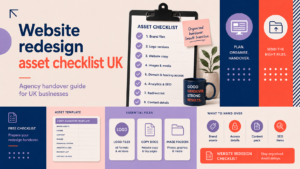
Compile SKUs, descriptions, variants, prices and images. Agencies often ask for CSV examples; our website redesign asset checklist explains the files commonly required.
Operational details
Document fulfilment methods, returns policy, VAT status and any restricted items. Clear operational notes help agencies estimate integrations and ongoing support needs.
Example content and competitor sites
List a few competitor stores and examples of features you like — this speeds discovery and ensures proposals match expectations.
How to choose an ecommerce agency in Birmingham
Questions to ask
- Can you show relevant examples and explain results (not promises)?
- Which platforms do you specialise in and what post-launch support is provided?
- How do you approach integrations, testing and training for our team?
How to compare proposals
Compare scope documents line by line: deliverables, milestones, testing, support and hosting responsibilities. Watch for vague scopes that leave integrations as “additional work”.
Red flags and realistic timelines
Avoid agencies that promise overly fast delivery without discovery or testing. Typical small-to-medium ecommerce builds take 6–12 weeks depending on complexity; bespoke builds take longer.
Launch and post-launch checklist
Pre-launch tests
- End-to-end purchase test using live payments (with a small refund after).
- Shipping label and fulfilment simulation for local and national orders.
- Form validation, 404 checks and backups.
Analytics, tracking and conversion goals
Configure analytics, set up conversion goals and add e‑commerce tracking to measure revenue and product performance.
Soft-launch, feedback and iterative improvements
Use a soft launch with staff, friends and local customers to gather feedback before wider promotion. Prioritise fixes and schedule iterative releases.
Customer service and returns processes
Ensure your customer service team has clear order lookup, refund and returns procedures before launch.
Next steps and recommended resources
If you want to DIY: focus on fast, secure hosting, a conversion-focused theme and essential plugins for payments, shipping and backups.
If you want an agency: prepare the asset checklist above and expect a discovery phase to refine scope and cost. For agency support see our E-commerce store design and platform pages.
Frequently asked questions
How much does ecommerce website design in Birmingham typically cost and how can I budget for it?
Costs vary by platform, catalogue size and integrations. Prepare a detailed brief and ask agencies for scoped quotes showing discovery, build and post-launch support.
Which platform is best for small retailers in Birmingham: Shopify or WordPress/WooCommerce?
Shopify is often quicker to launch with less maintenance. WordPress + WooCommerce suits content-led stores that need flexibility. Choose based on inventory size, editorial needs and planned integrations.
How long does it usually take to build and launch an online store?
Expect 6–12 weeks for a typical small-to-medium store. Complex or custom builds take longer.
What information and assets should I prepare before contacting an ecommerce agency?
Provide brand assets, product CSVs and images, fulfilment details, examples of sites you like and any required integrations to get accurate proposals.
How can I reduce cart abandonment on my ecommerce site?
Simplify checkout, offer guest checkout, show clear delivery costs early and provide trust signals like reviews and secure payment badges.
Request a free consultation with Logo Metic to discuss your ecommerce project and get practical advice for your Birmingham store. Email support@logometic.co.uk or call +44 7883 180004 to arrange a meeting.