
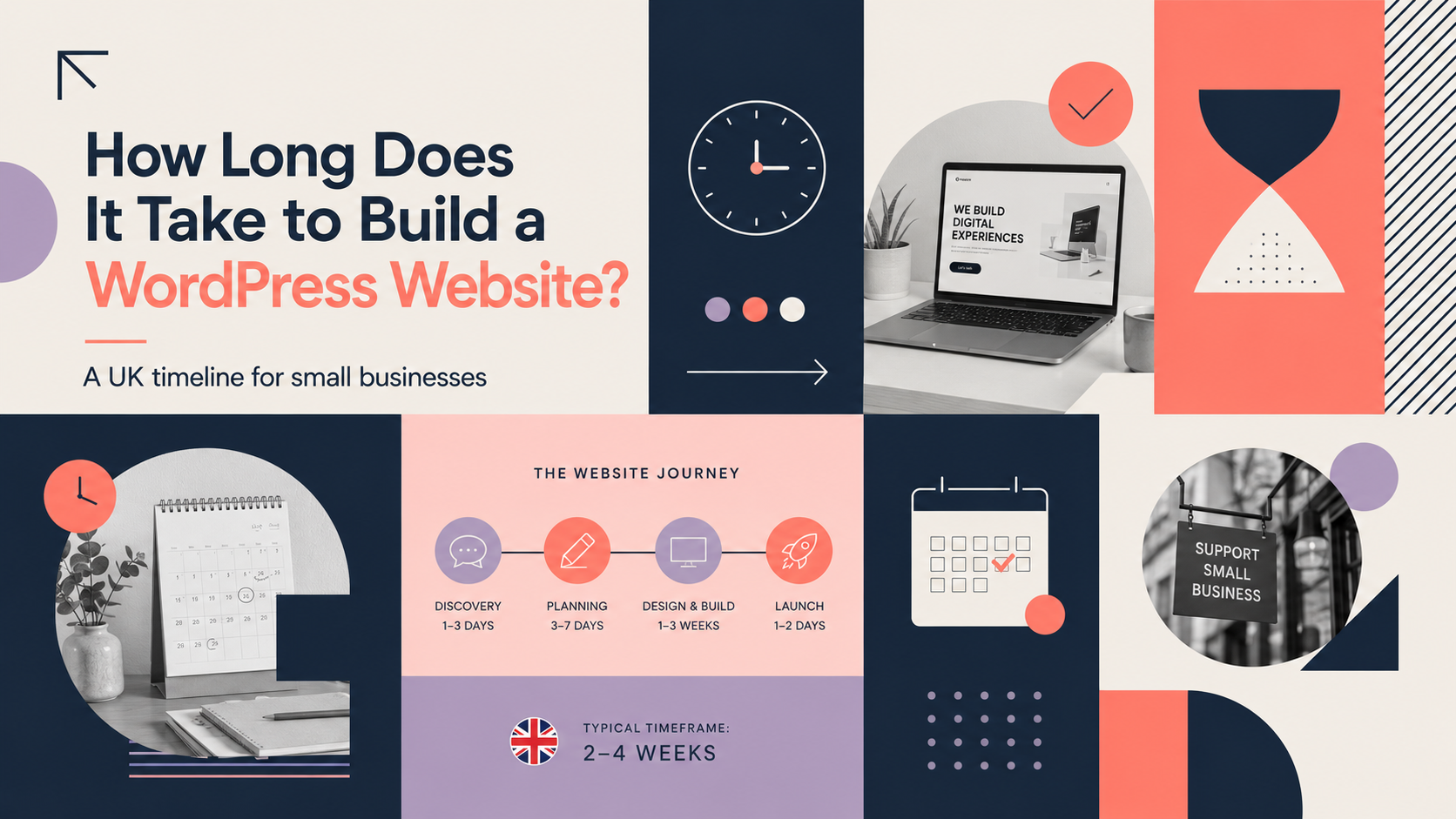
If you’re asking how long does it take to build a WordPress website, this guide gives UK small-business owners realistic timelines for different project types, explains each project stage, highlights common delays and provides sample schedules and checklists. Use it to decide whether to DIY, use a template or request a consultation with Logo Metic.
Typical WordPress website timeline — a quick overview
What a ‘timeline’ means: phases, dependencies and delivery milestones
A timeline is a sequence of project phases with expected durations and key milestones. Typical phases are discovery, design, development, content population, testing and launch. Actual delivery depends on dependencies such as content, 3rd-party accounts and client approvals.
Typical time ranges for common project types
High-level ranges for small UK projects are useful for planning (these are example ranges, not guarantees):
- Small brochure site (5–8 pages, minimal customisation): often a few days to 3 weeks if assets and content are ready.
- Standard small-business site (service pages, blog, contact forms): typically 3–6 weeks including content and modest design revisions.
- Ecommerce store (catalog, payments, shipping): typically 6–12 weeks depending on product count and payment/shipping setups.
- B2B or custom-feature sites (CRM integrations, gated content): often 8–16+ weeks, because of complex integrations and approvals.
When timelines overlap
Several tasks can run in parallel. For example, design and content planning may overlap with development of the theme framework. However, content and approvals are common bottlenecks that pause later stages.
Project stages: step-by-step timeline breakdown
Discovery & brief — goals, audience, scope and technical requirements
Discovery clarifies objectives, audience and technical needs. Expect 1–5 days for a focused brief. A clear brief shortens the whole project.
Sitemap, content plan and page outlines
Create a sitemap and basic page outlines. This stage defines which pages exist and who is responsible for content. For guidance on which pages to include, see our What Pages Does a Small Business Website Need? guide.
Design — wireframes, visual concepts and revisions
Design usually includes wireframes and one or two visual concepts. Allow 1–3 weeks depending on how many revisions are needed and how quickly feedback is returned.
Development — theme/template setup, customisation and integrations
Development covers theme or template set-up, custom styling, and integrations such as contact forms, analytics, or CRM connections. If using a page builder or pre-built theme, development can be quicker. Custom features and integrations take longer.
Content population and on-page SEO
Populating content and basic on-page SEO (titles, meta descriptions, headings) can take several days to a week for a standard site. If the client supplies content and images upfront, this stage is much faster.
Testing, accessibility checks and quality assurance
Testing across browsers and devices, plus basic accessibility and performance checks, should be scheduled for at least 2–5 days. UK businesses should also confirm cookie and privacy controls are in place.
Launch, handover and post-launch monitoring
Launch includes DNS changes, backups and a final test. Handover involves admin account access and simple training. Post-launch monitoring is recommended for the first 1–2 weeks to fix any immediate issues.
Timeline examples by project type (practical templates)
Small brochure website — one realistic timeline template
- Day 1–3: Brief and sitemap sign-off.
- Day 4–10: Template selection and basic design customisation.
- Day 11–14: Content population and SEO basics.
- Day 15–18: Testing and client review.
- Day 19–21: Launch and handover.
Standard small-business site — timeline template
- Week 1: Discovery and sitemap, assign content owners.
- Week 2–3: Design concepts and revisions.
- Week 4–5: Development and integrations.
- Week 6: Content population, SEO and testing.
- Week 7: Final fixes, training and launch.
Ecommerce store — timeline template and extra tasks
Ecommerce adds product set-up, payment gateway configuration and shipping rules. See our e-commerce web design page for service details. A simple shop with under 50 products can often be delivered in 6–8 weeks; larger catalogues or bespoke checkout flows typically take longer.
B2B or custom-feature sites — typical longer timelines and why
B2B projects often require CRM integrations, user roles, document downloads and secure areas. These features add discovery time, additional testing and longer client sign-off cycles. If your project is B2B, you may find our B2B web design guidance useful.
Common factors that speed up or slow down a WordPress build
Client-side factors: content readiness, decision speed and approvals
Providing content, images and timely feedback reduces delays. Assign a single project contact with authority to approve decisions where possible.
Technical factors: customisation, third-party integrations and plugins
Custom code, complex integrations and unfamiliar plugins add time. Common plugin setups such as WooCommerce or payment gateways require configuration and testing.
Scope creep, change requests and late feature additions
Late feature requests extend timelines. Agreeing a change-management process in the brief keeps the project on track.
Compliance and accessibility requirements for UK businesses
GDPR-related privacy and cookie controls, plus basic accessibility checks, should be planned in. More rigorous accessibility audits increase time and cost, so state requirements clearly at the start.
DIY, templates or hiring an agency: which is faster?
When a template or page-builder speeds the process — pros and cons
Using a pre-built theme or page builder (e.g. Elementor, Beaver Builder) can cut initial build time. The trade-off is potential performance and maintenance burdens. Templates are best when you have clear content and limited custom features.
When agency delivery is faster and where it adds value
An experienced agency coordinates design, content and technical tasks in parallel and handles testing, security and handover. For many small businesses this saves time overall, especially for ecommerce or B2B projects.
How to brief an agency to reduce delivery time
A clear brief, complete content, brand assets and timely approvals reduce the delivery window. Include technical details, desired integrations and a realistic approval timeline.
How to speed up your WordPress project: a practical checklist
Pre-project checklist: content, images, logins and technical details
- Decide pages and provide final copy where possible.
- Gather brand assets (logo, colour palettes). If you need a logo, see our custom logo design service.
- Provide hosting and domain logins or ask the agency to recommend options.
- Prepare any product lists and images for ecommerce.
Decision checklist for designs, plugins and integrations
- Approve one visual concept to avoid multiple revisions.
- Decide on analytics, tracking and email integrations early.
- Confirm payment gateways and test accounts for ecommerce.
Launch-readiness checklist (testing, backups, redirects)
- Complete cross-browser and mobile testing.
- Set up backups and a rollback plan.
- Prepare redirects from old URLs and check SEO basics.
For an expanded preparatory list, our WordPress website design checklist for UK small businesses is helpful.
What to include in the brief, contract and timeline agreement
Clear scope, milestone dates and approval windows
Specify deliverables, milestone dates and how long clients have to approve work at each stage. This prevents misunderstandings and hidden delays.
Stated responsibilities
Make responsibilities explicit: who supplies content, images, third-party accounts and who handles maintenance after launch.
Change management and how extra work affects timelines
Include a change control process. Extra features should be logged, costed and scheduled separately so the core timeline remains visible.
Next steps: choosing the right route and contacting Logo Metic
Decide which sample timeline matches your project
Match your needs to the sample timelines earlier in this guide. If you have limited content and want a simple brochure site, a shorter timeline is realistic. For ecommerce or B2B features, expect longer delivery windows.
How to prepare for a consultation to get an accurate timescale
Bring your brief, list of required integrations, product counts (if applicable) and sample assets. The clearer the brief, the more accurate the timescale an agency can provide.
Suggested next actions and contact details
If you’d like professional help, request a WordPress website consultation with Logo Metic to discuss your project and receive an accurate timeline. For ecommerce-specific projects, consider our e-commerce web design service, and if you are weighing platform choices we can advise on alternatives such as Shopify web design. For responsive redesigns that need extra testing, see our responsive web design service.
Frequently asked questions
How long does it typically take to build a simple brochure WordPress site for a UK small business?
With content and assets ready, a simple brochure site can often be built in under three weeks. If content needs writing or approvals are slow, plan for a longer schedule.
What adds the most time to a WordPress project (content, integrations or design revisions)?
The most common delays are waiting for content and extended design revisions. Complex integrations and bespoke development are next in line for adding time.
Can a WordPress site be built faster if I provide all content and images upfront?
Yes. Supplying final content, images and login details at the project start significantly speeds delivery and reduces back-and-forth.
How do ecommerce features affect the timeline compared with a standard business website?
Ecommerce requires product setup, payment and shipping configuration and additional testing. That usually extends the project by several weeks depending on product volume and payment complexity.
What should I include in my brief to get an accurate timeline and fixed milestones?
Include project goals, page list, expected integrations, product counts (if relevant), desired launch date, and who will supply content and approvals.
Request a free consultation with Logo Metic — if you want a tailored timeline for your project, request a WordPress website consultation and we’ll review your brief and provide a clear delivery plan.