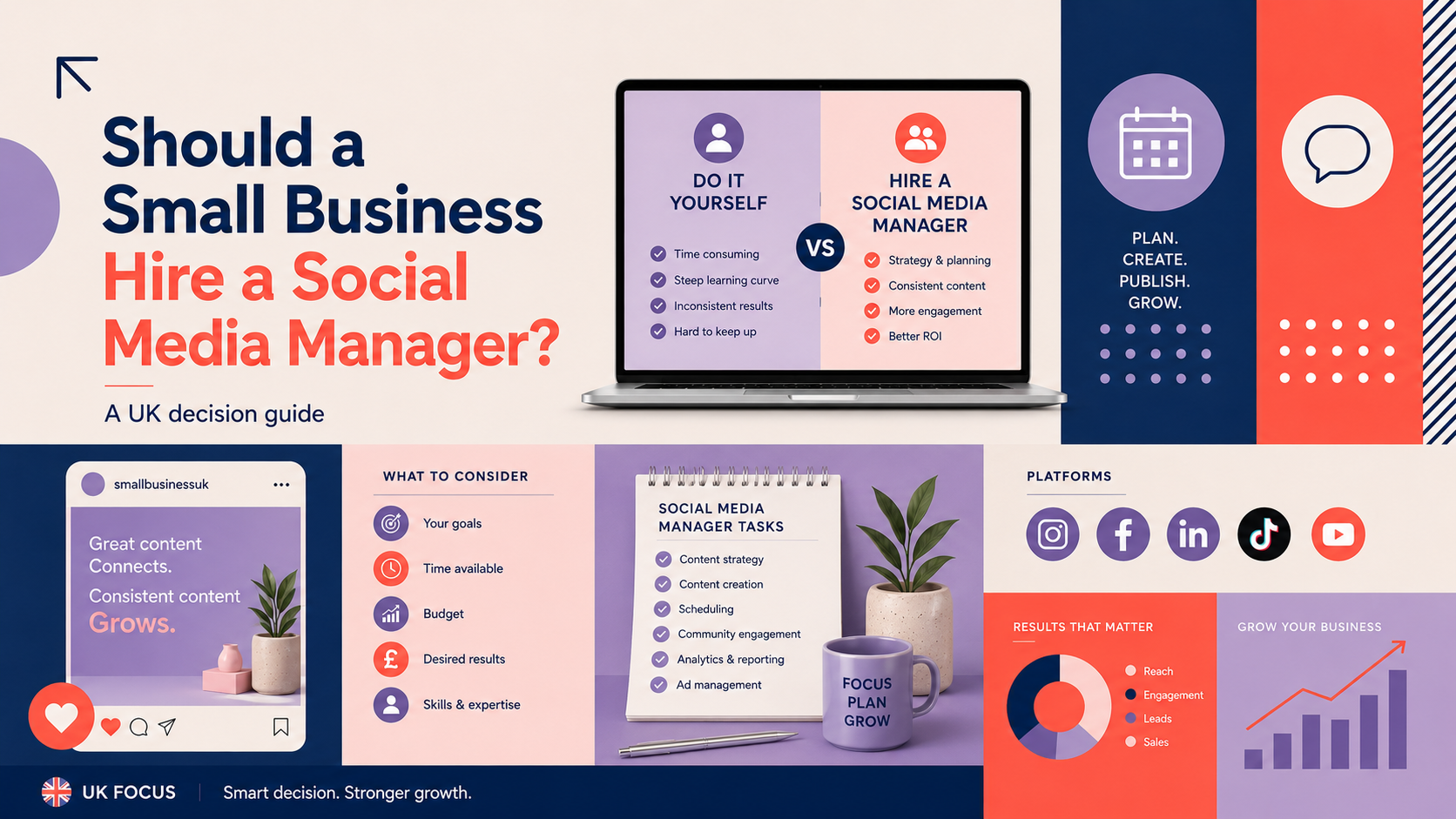
This guide helps UK small businesses and startups answer the central question: should small business hire social media manager? If you run a small team, have limited marketing hours or are weighing freelancer versus agency options, this article sets out the practical factors to consider — time, skills, goals, budget and legal compliance — and a decision framework to act on straight away.
Why the question matters for UK small businesses
Social media can support brand awareness, lead generation, customer service and direct sales. For small businesses in the UK the challenge is balancing those benefits against tight resources and specific regulatory obligations such as GDPR. The right approach depends on what you need social media to achieve and how much internal capacity you have to sustain it.
What a social media manager does (quick overview)
A competent manager plans content, creates or briefs creative, schedules posts, engages with followers, manages paid campaigns, monitors performance and reports results. They also handle reputation issues and keep activity compliant with platform rules and data protection requirements.
How social media supports common small business goals in the UK
- Local visibility and footfall for shops and services.
- Lead capture and nurturing for B2B and professional services.
- Product promotion and direct sales for e-commerce retailers.
- Customer care and community building for repeat business.
Key constraints for small businesses: time, budget and skills
Most small teams underestimate the ongoing time needed for consistent, quality social activity. If you lack design skills, ad know-how or measurement experience, social media can consume time without producing reliable outcomes. That trade-off is central to the hiring decision.
should small business hire social media manager
Use this practical decision framework to decide now: a short checklist, three outcomes and example scenarios that make each option clearer.
Quick checklist: 8 questions to decide
- Do you have regular time (2–8 hours/week) to manage channels consistently?
- Is consistent, quality content essential to your growth goals?
- Do you need paid advertising expertise?
- Do you or your team have basic design and copy skills?
- Are you handling customer data or messages that raise GDPR concerns?
- Could a public complaint or crisis damage your business quickly?
- Can you measure success (website analytics, social metrics, sales)?
- Do you have a realistic budget for ongoing support?
Decision outcomes explained
- Keep in-house — choose if you have time, basic skills and simple goals (local updates, community replies). Use scheduling tools and a content plan to maintain consistency.
- Outsource to a freelancer — suitable for predictable content needs, lower budgets and single-channel focus. Good for one-off campaigns or part-time support.
- Hire an agency — better when you need strategy, paid media, creative production and reporting at scale. Agencies can also advise on integration with branding and web presence.
- Hybrid — a part-time employee handles community and local updates, with an agency or freelancer for strategy, ads and creative bursts.
Example scenarios
- Startup — needs brand awareness and lead generation; lean towards an agency or hybrid to get strategy and ad expertise quickly.
- Local shop — needs regular local posts and community replies; an in-house owner/operator supported by a freelancer for promotions often works.
- eCommerce retailer — requires product creative, ads and conversion tracking; agency support or specialist freelancer plus close website integration is recommended.
- Service business — professional services benefit from consistent thought-leadership posts; a part-time manager with occasional agency support can be efficient.
- Beauty salon or spa — niche content and booking-driven goals can benefit from specialist ideas; see our practical content examples in social media ideas for spas UK: 30 creative content ideas for beauty salons.
Options for outsourcing social media management
Freelancer: when it works and when it doesn’t
Freelancers are cost-effective for predictable, limited scopes: content creation for one channel, community management, or short campaigns. They can lack capacity for large paid media programmes or multi-channel strategy and may introduce single-person risk if they are unavailable.
Specialist social media agency: pros/cons
Specialist agencies bring up-to-date platform expertise and campaign experience. They suit businesses that need regular paid activity, advanced creative or cross-channel campaigns. Expect higher cost but broader capability and often better reporting.
Full-service creative or web agency: when integration matters
If your social activity needs close alignment with branding, creative assets or website changes, a full-service agency can keep work integrated. That reduces rework between brand, design and web teams and improves conversion from social posts to your site.
Hybrid models: part-time employee + agency support
Many small businesses find a hybrid approach cost-effective: internal resource for day-to-day engagement and an external partner for strategy, ads and seasonal campaigns.
What a competent social media manager should deliver
Core responsibilities
- Content strategy aligned to business goals.
- Monthly content calendar and scheduled posts.
- Creative asset production or briefs for designers.
- Community management and customer responses.
- Paid media setup and optimisation (where required).
- Monthly reporting and insights with recommended actions.
Monthly deliverables checklist
- Content calendar for the month.
- Set number of posts and creative assets ready for scheduling.
- Paid media plan and ad creatives if applicable.
- Engagement summary and top-line metrics.
- Next-month recommendations and test ideas.
To assess candidates or agencies, ask for a sample content calendar — our social media content calendar for small business UK: monthly social media plan template is a practical reference when reviewing proposed deliverables.
Cost, time and performance considerations
Cost drivers to check in every quote
- Strategy and planning time.
- Number of posts and creative assets per month.
- Paid media management fees and ad spend handling.
- Reporting frequency and depth.
- Additional services: photography, video, influencer management.
How to evaluate value: sample KPIs and reporting cadence
- Reach and impressions for awareness goals.
- Engagement rate and message response times for community health.
- Website traffic and conversions for lead generation or sales.
- Cost-per-click or cost-per-acquisition for paid campaigns.
Request monthly reports with context and recommended next steps, not just raw numbers. Agree a trial period (often 1–3 months) to judge capability before committing long-term.
Hiring and briefing: templates and interview questions
Job/brief template
- Goals: clear objectives and desired KPIs.
- Scope: channels, posting frequency, paid ads, creative production.
- Deliverables: content calendar, monthly report, ad management.
- Access required: social accounts, analytics, website, creative assets.
- Tools preferred: scheduling, analytics and asset storage.
5 practical interview questions and a short test task
- Describe a recent campaign you planned and what you learned from its data.
- Which channels would you prioritise for our business and why?
- How do you handle negative comments or a public complaint?
- How do you measure success for a low-budget local campaign?
- Give an example of a content test you would run in month two.
Test task: ask for a one-week content plan for a named channel and one mock post with caption and suggested creative.
Contract essentials and GDPR/access checklist
- Define contractor vs employee status carefully (see HMRC and ACAS guidance when hiring).
- Specify data access limits, password and account-handling procedures.
- Agree ownership of creative assets and access handover at contract end.
- Include confidentiality, notice periods and liabilities for policy breaches.
When the decision should include branding, website or ecommerce changes
Signs your brand or website is holding social channels back
- Poor conversion rates from social traffic to meaningful actions.
- Inconsistent visual identity or messaging across posts and site.
- Slow site performance or difficult checkout that loses sales.
If social posts drive traffic but the website experience is weak, it may be a web issue. Our WordPress web design services can help improve on-site conversion, and our guide Signs Your Business Website Needs a Redesign: A practical diagnostic guide for UK small businesses helps diagnose common problems.
How integrated work (brand + website + social) improves results
Consistent brand identity and clear website journeys reduce friction from social to sale or enquiry. For businesses where branding is inconsistent, professional identity work is often the most cost-effective first step; consider our brand identity design service for full brand alignment.
Suggested next steps if you need a new logo, brand identity or website
If you identify brand or logo weaknesses, start with a focused brand or logo brief. For logo work see custom logo design. Retailers whose social channels drive sales but whose store experience needs improvement should consider a dedicated e-commerce store design project.
Practical next steps and a 30/60/90-day checklist
30 days: onboarding and quick wins
- Agree goals and KPIs, provide access and brand assets.
- Publish a one-month content calendar and schedule immediate posts.
- Run a small paid test if budget allows and capture baseline metrics.
- Use the WordPress website design checklist for UK small businesses during onboarding to capture site-related quick wins.
60 days: optimisation and reporting setup
- Analyse early results, refine audience targeting and creative.
- Set up consistent reporting cadence and conversion tracking.
90 days: review, KPI evaluation and go/no-go decision
- Review performance against agreed KPIs and decide whether to continue, scale or change approach.
- Document lessons and update the content strategy for the next quarter.
Common mistakes to avoid and final recommendations
Top 6 mistakes small businesses make with social media management
- No clear brief or measurable goals.
- Expecting immediate sales without a tested funnel.
- Ignoring measurement and failing to iterate.
- Mixing too many, conflicting goals in one campaign.
- Poor access controls and GDPR oversights.
- Choosing the cheapest option without checking deliverables.
How to avoid them
Be explicit about goals, ask for examples of previous work, demand a sample content calendar and agree a trial period with clear KPIs. Protect data and account access contractually and monitor reporting closely.
Final recommendation and next step
If you lack regular time, specialist ad skills or consistent creative capacity, outsourcing (freelancer, specialist or agency) is often the sensible route. If your social work is closely tied to website performance or branding, consider integrated work first. For personalised advice and a free consultation, request a free consultation with Logo Metic or contact support@logometic.co.uk or call +44 7883 180004 to discuss your social media, branding or website needs.
FAQ
How do I decide whether to hire a social media manager or outsource social media management?
Use the eight-question checklist above. If you lack time, skills or need paid media expertise, outsourcing is usually more efficient; if you need tight local control and have capacity, keep it in-house.
What exactly should I expect a social media manager to deliver for my small business?
Expect a content strategy, a monthly content calendar, creative assets or briefs, scheduled posts, community management, paid media execution if agreed, and monthly reports with recommendations.
Can outsourcing social media management save my business time and money?
Yes, when it frees internal capacity and provides better-targeted ad spend and creative. Compare quotes by scope, deliverables and expected outcomes rather than price alone.
How long does it typically take to see results after hiring a social media manager?
You should expect initial signals within 30–60 days and clearer evidence by 90 days. Agree a trial period and specific KPIs to judge effectiveness.
What legal or GDPR considerations should I include when hiring someone to manage my social accounts?
Limit account access, agree data handling processes, clarify ownership of assets and specify confidentiality and notice periods in contracts. For detailed legal guidance consult HMRC or ACAS and a qualified adviser where necessary.
Request a free consultation with Logo Metic to discuss whether to hire, outsource or integrate social media with your brand and website. For a direct enquiry email support@logometic.co.uk or call +44 7883 180004.