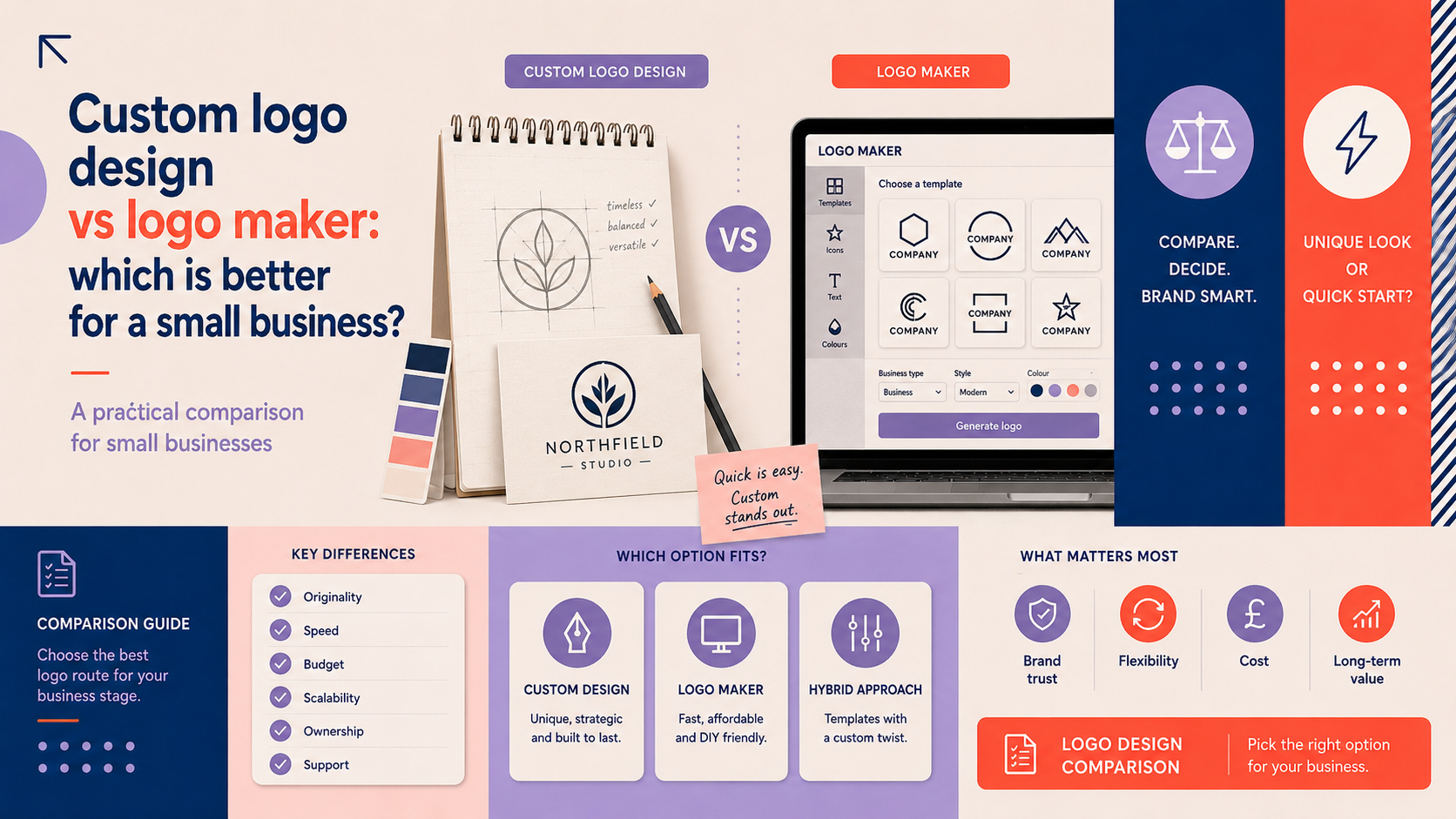
Choosing between custom logo design and a logo maker is one of the first branding decisions for many small businesses. This article compares custom logo design vs logo maker across the practical factors that matter to UK small businesses: cost, speed, quality, ownership, file formats and future growth. Read on to map your situation to the right choice and follow a simple checklist to decide.
What we mean by custom logo design and logo makers
What is custom logo design? (process, human creativity, briefing, revisions)
Custom logo design is a human-led service where a designer or design team creates a logo from a brief. The process typically includes a discovery phase, research into competitors and audience, concept sketches, revisions, and delivery of final files. A bespoke design is created to reflect your business strategy, tone and target customers; it is tailored rather than chosen from pre-made options. If you want to explore bespoke work, see our custom logo design services for startups and small businesses.
What is a logo maker? (template-based and AI-powered options, quick output, limitations)
Logo makers are online tools that produce logos from templates or by using automated design algorithms. Some use simple templates you edit; others use AI to generate variations from keywords. They are fast and inexpensive and can be useful for test ventures or quick placeholders. Limitations include less originality, packaging of fonts and layout choices you cannot change deeply, and variable legal clarity about ownership depending on the provider.
When small businesses typically consider each option
Many sole traders and test ventures start with a logo maker to get a visual quickly. Businesses that expect to trade publicly, use printed materials, build a website or apply for trademarks usually benefit from a custom designer, who can deliver unique artwork and the right file set for multiple uses.
How they compare: practical factors for small businesses
Cost and budgeting: short-term spend vs long-term value
Logo makers are cheaper up front, often with low monthly or one-off fees. Custom logo design costs more because of time spent on research and creative work. Cost should be weighed against long-term value: a bespoke logo can reduce future rework and provide files and guidance designed for real marketing use. For detailed budgeting for UK small businesses, our professional logo design cost UK: a practical cost guide for small businesses explains typical ranges and what to expect for different levels of service.
Quality and distinctiveness: template limits vs bespoke creativity
Template and AI outputs can look professional at a glance, but are often similar to other logos and limited by the library of assets available. A custom designer can produce a distinctive mark aligned to your strategy, which helps with recognition and reduces the risk of similarity to others in your sector.
Speed and turnaround: immediate logos vs iterative design
If you need something immediately for a social post or prototype, a logo maker can deliver in minutes. Bespoke design takes days to weeks, depending on scope and revisions. The right choice depends on whether speed or refinement is the priority.
Ownership, copyright and trademark considerations
Ownership terms vary by logo-maker provider; some give commercial use rights, others licence assets with restrictions. Bespoke work typically comes with clearer assignment of copyright when agreed in contract, which helps if you later register a trademark. When legal protection matters, seek clear written terms and consider professional legal advice for trademark registration with the UK Intellectual Property Office.
File formats, scalability and future-proofing
Professional designers provide vector files (for example, scalable artwork) plus colour specifications and web-ready formats. Logo makers sometimes restrict file types or provide raster images that are not suitable for large-format printing. For future-proofing, ensure you receive scalable vector files and colour values for print and digital use.
Support and ongoing brand assets (brand guidelines, variations)
Custom design often includes or offers additional brand assets such as colour palettes, type choices and usage rules. Many logo makers provide basic variations, but not full guidance. If you plan consistent marketing across packaging, vehicles, signage and a website, the extra support from a designer or a brand identity project is valuable.
Which option suits different types of UK small businesses?
Sole traders and test ventures
For a short-term test or hobby project, a logo maker can be a sensible first step. Keep in mind you may need a proper identity if the venture grows.
Local high-street shops and tradespeople
Local businesses that rely on repeat customers and physical branding (signage, van livery, shopfronts) usually benefit from a custom logo. A designer will provide files suitable for large-format printing and consistent application.
Online retailers and e-commerce startups
E-commerce businesses should consider brand distinctiveness and web-ready assets. If you plan to scale or sell across platforms, a bespoke logo and identity are worthwhile; for purely experimental shops, a logo maker may suffice in the short term. If you need help with your online presence, we can discuss your ecommerce store project.
Service businesses and professional practices
Professional service firms (accountants, consultants, clinics) often rely on reputation and trust. A tailored, considered identity supports perception and client confidence, so a custom route is usually the better long-term investment.
Businesses planning to scale or rebrand
If you plan to scale, franchise, or rebrand, start with a bespoke identity. Custom work anticipates variations and new applications and reduces the likelihood of a costly redesign later.
Decision checklist and quick decision matrix
8-point decision checklist
- Budget: Do you have funds for professional design or need a low-cost start?
- Timeline: Do you need a logo immediately, or can you wait for an iterative process?
- Uniqueness: Is distinction important in your market?
- Legal certainty: Will you need clear ownership or trademark protection?
- Files: Do you require vector files and multiple colour variations?
- Brand growth: Will the business expand or diversify soon?
- Marketing channels: Do you need physical print, signage or vehicle graphics?
- Technical needs: Do you need responsive or animated versions for digital use?
Three-step decision matrix: choose A, B or C
- If most checklist items point to low budget, immediate need and limited long-term growth → A: logo maker.
- If you require uniqueness, legal certainty, and multiple file types → B: custom designer.
- If you want to start cheaply but leave room to upgrade → C: hybrid approach (start with a maker, plan to commission a custom identity later).
Example scenarios with recommended choice (short UK examples)
- New sole trader testing a weekend market stall: logo maker to begin, upgrade if sales grow.
- Independent café with plans for signage and uniforms: custom designer for print-ready files and consistent application.
- Online boutique with ambitions to scale internationally: bespoke logo and identity plus professional web design.
How to get the best result from either route
Briefing a custom designer: what to include and expect
Provide a concise brief covering: business purpose, target customers, competitor examples, tone and personality, primary use cases (web, print, vehicle), colour preferences and any mandatory elements. Expect research, concept exploration and a revision period. Clear feedback speeds the process.
Getting better results from a logo maker or AI tool
Use clear keywords that describe mood and industry, limit colour choice for clarity, and iterate the design rather than accepting the first result. Download the highest-quality files the tool offers and test the logo at different sizes and backgrounds.
Essential file and deliverables checklist to request
- Vector master file (editable vector format).
- SVG for web and PDF for print.
- PNG with transparent background in multiple sizes.
- Colour specifications (Pantone if needed) and HEX/RGB values.
- Black-and-white and reversed (light on dark) variations.
- Basic usage guidelines (spacing, minimum size).
When to upgrade from a maker to a bespoke identity
Upgrade when you need trademark protection, consistent cross-channel use, professional-level print files or a more distinct brand presence. Many businesses begin with a maker then commission a full identity once revenue or commitment is proven.
When to consider professional brand identity and web design
Why a logo is just one part of a brand
A logo signals your brand but does not define it alone. Colour, typography, tone of voice, photography and website experience together form how customers perceive your business.
When to commission a full brand identity
Commission full identity work when you need consistent customer experience across marketing, or when entering competitive markets where differentiation matters. For businesses that need a complete identity package, discuss a complete brand identity with our team.
How a good website completes your brand (shop and service examples)
A well-designed website presents your brand, supports sales and handles enquiries. If your branding work leads to a site brief, you can Request a WordPress website consultation to discuss how the brand translates online.
Next steps and how Logo Metic can help
If you prefer a bespoke route, request a custom logo consultation to discuss your goals and get a tailored proposal.
Further reading and resources
- professional logo design cost UK: a practical cost guide for small businesses — budgeting help for UK businesses.
- Benefits of Animated Logo: How Logo Animation Improves Social Media and Video Branding — ideas for using logos beyond static files.
- WordPress website design checklist for UK small businesses — align your branding with website requirements.
Frequently asked questions
Is a logo maker good enough for a new small business?
Yes, for early testing or very low budgets a logo maker can be good enough as a temporary solution. If you plan public trading, signage or trademarking, a custom approach is usually better long term.
Will I own the logo if I use an AI logo maker?
Ownership depends on the provider’s terms. Some services grant commercial use rights; others restrict reuse. Always read the terms carefully and get written confirmation of ownership or licensing before using the logo commercially.
How much should a UK small business budget for a professional logo?
Costs vary by scope and the designer’s experience. For a practical guide to expected costs at different levels, see our professional logo design cost UK: a practical cost guide for small businesses.
Can I start with a logo maker and upgrade to a custom designer later?
Yes. Many businesses start with a maker and later commission bespoke work. Keep initial files organised and be prepared to invest in a redesign when the business commits to long-term branding.
What file types should I ask for when I buy a logo?
Request a vector master file, SVG, PDF, PNGs with transparent backgrounds and colour specifications (HEX/RGB and print references). Also ask for black-and-white and reversed colour variations and simple usage guidance.
Request a free consultation with Logo Metic — if you want to discuss whether a custom logo or a maker suits your UK business, request a free consultation with Logo Metic by contacting us via the custom logo service page linked above.