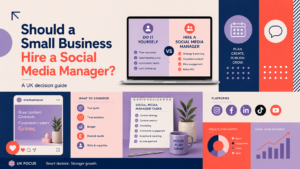


social media content design roi uk matters because creative work should drive measurable business outcomes, not just likes. This guide explains how a small business in the UK can define goals, set up tracking, test creative, attribute results and build a monthly ROI dashboard — without expensive enterprise tools.
Why measuring social media content design ROI matters for small businesses
What we mean by ‘social media content design ROI’
Here ROI means the measurable business value gained from investment in social creative: the sales, leads or other conversions that can reasonably be assigned to visual and written content made specifically for social channels, after accounting for production and placement costs.
Common small-business goals: awareness, engagement, leads and sales
- Awareness: reach and view-throughs for new products or seasonal offers.
- Engagement: saves or shares that increase organic distribution.
- Leads: enquiries, form completions or phone calls.
- Sales: online purchases or in-store conversions linked to campaigns.
Myths and mistakes to avoid (vanity metrics vs business metrics)
High follower counts and likes are useful signals, but they are not ROI unless they lead to measurable business outcomes. Start by mapping creative activity to the smallest set of outcomes that matter to your business (leads and sales).
Step 1: define clear goals and the metrics that map to them
Typical goal-to-metric mappings (examples for UK SMEs)
- Drive online sales → purchases, revenue, add-to-basket rate.
- Generate local leads → form submissions, phone calls, booking requests.
- Improve awareness before launch → impressions, view-through rate, aided brand recall (survey).
Primary metrics: conversions, revenue, leads
Pick one primary metric that maps directly to business value, for example number of purchases or qualified leads per campaign. Secondary metrics support diagnosis but should not replace primary metrics.
Secondary metrics: engagement rates, CPM/CPC, view-through
Use engagement rate, cost-per-click (CPC) and cost-per-mille (CPM) to understand creative efficiency and reach. View-through conversions (people who saw but did not click) can be important for video-led creative.
Step 2: set up tracking and data sources
Platform analytics (Meta, X, TikTok, LinkedIn) — what they show
Each platform provides impressions, clicks, engagements and some conversion reporting for ads. Use platform reports to compare creative variants, but do not rely on platform-only attribution for full business value.
Website tracking: GA4 basics, events and conversion setup
Configure GA4 to record events that matter (purchase, lead form submit, phone click). Mark the most important events as conversions so you can report them consistently. If you need help making sure landing pages and forms are conversion-ready, consider a WordPress website consultation for small businesses to ensure tracking works reliably.
UTM parameters and campaign naming conventions (simple template)
Add UTMs to every social link so GA4 and other analytics attribute traffic correctly. A simple convention is:
- utm_source=platform (meta, x, tiktok, linkedin)
- utm_medium=social
- utm_campaign=YYYYMM_product_or_promo
- utm_content=creative_variant
This lets you see which creative_variant drove the clicks and conversions.
Using CRM and sales data to close the loop
Export lead and sales data from your CRM and match by timestamp or UTM campaign where possible. This is essential to connect offline or phone sales back to social creative.
Step 3: attribute results sensibly and avoid common pitfalls
Attribution model overview: last click, first click, multi-touch
Choose an attribution model appropriate to your sales cycle. Last-click is simple but can under-credit awareness creative; multi-touch spreads credit among touch-points. Small teams often start with last-click for simplicity, then move to simple multi-touch when data volume allows.
When multi-touch matters for design-led campaigns
If your campaign relies on a sequence of creative (teaser → launch → retarget), multi-touch attribution helps value each creative stage. It is particularly useful where creative drives view-through conversions from video or carousel ads.
Pitfalls: hidden delays, cross-device and view-through conversions
- Conversion delay: a customer may convert days after seeing creative; set a sensible lookback window.
- Cross-device: users may see an ad on mobile but convert on desktop — ensure tracking and CRM capture UTM or identifiers where possible.
- View-through: platforms may count conversions from impressions. Note this separately and avoid double-counting.
Step 4: measure the creative impact — tests and experiments
What to test: imagery, copy, CTAs, format and duration
Test one variable at a time where possible: a new image, a different CTA button, or a shorter video. Changing multiple elements simultaneously makes it hard to learn.
Simple A/B test workflow for social posts and ads
- Define hypothesis: e.g. “Image A will drive a 10% higher click-through rate than Image B.”
- Allocate equal budget and identical audience targeting.
- Run the test for a minimum time or impressions threshold (e.g. 3–7 days or 1,000+ impressions).
- Compare primary metric (clicks or conversions) and check secondary metrics for signal quality.
Example test plan with sample hypotheses and success criteria
Hypothesis: “Short-form vertical video increases conversions by reducing CPC.” Success criteria: 15% lower CPC and equal or better conversion rate over 7 days.
Use the social media content calendar template for small businesses to schedule tests and preserve clear start/end dates for reporting.
Step 5: calculate ROI — formulas and worked examples
Basic ROI formula for social content design
ROI = (Attributed revenue − Cost of creative and placement) ÷ Cost of creative and placement
Include production costs (designer time, asset creation) plus media spend for ads in the denominator.
Attribution-adjusted ROI example (sample calculation using realistic placeholders)
Example (replace placeholders with your numbers):
- Attributed revenue from campaign (GA4 + CRM): £4,000
- Production cost (design, copy, video): £600
- Ad spend: £900
- Total cost = £1,500
- ROI = (£4,000 − £1,500) ÷ £1,500 = 1.67 (or 167%)
If you use attribution weights (for multi-touch), adjust the attributed revenue accordingly before calculating ROI. If your business sells online, consider working with an ecommerce store design for online retailers specialist to ensure revenue tracking is accurate.
When to use cost per acquisition (CPA) and lifetime value (LTV)
Use CPA when your goal is immediate conversions. Use LTV when customers make repeat purchases — divide estimated LTV by CPA to judge long-term value of creative investments.
Step 6: reporting — build a simple monthly ROI dashboard
Essential dashboard fields and visuals (spreadsheet or Data Studio style)
- Campaign name, platform, creative variant
- Impressions, clicks, CTR, CPC
- Conversions, attributed revenue, CPA
- Production cost, media spend, ROI
- Test flags and statistical significance notes
Monthly reporting checklist (data checks, test notes, next actions)
- Verify UTMs and GA4 conversion counts match CRM where possible.
- Note any cross-campaign overlaps or reused creatives.
- Record next steps: iterate, scale or stop.
How to present creative learnings (what to keep, iterate or stop)
For each creative, record one clear recommendation: keep (scale), iterate (small changes), or stop (poor performance). Use visuals or thumbnails in the report to make decisions faster.
Practical tactics to improve ROI from content design
Design best practices that lift engagement and conversions
- Clear visual hierarchy and prominent CTA.
- Brand-consistent colours and typography for recognition.
- Short, scannable text for mobile-first audiences.
Strong branding helps creative work punch above its weight — if you need a new mark, consider a custom logo consultation for startups and small businesses to ensure assets are consistent and reusable.
Accessibility and inclusive design as performance drivers
Accessible content (readable fonts, alt text, captions) widens reach and can improve engagement. See our guide to accessible social media graphics: a practical guide for tactical tips.
Reuse and templating to reduce cost per asset
Create templates and component libraries so you can produce more variants faster and reduce production cost per post. A clear brand system makes templating easier; read more about brand identity design for growing businesses if you plan a rebrand or systemisation.
Deciding when to handle in-house and when to hire help
Capacity and capability checklist for small teams
- Do you have a designer who can produce timely variants?
- Is someone accountable for tracking and reporting?
- Can the team run simple A/B tests and act on results?
What to include in an agency brief (deliverables, KPIs, reporting cadence)
Ask for deliverables, test plans, expected timelines and KPIs (primary metric + secondary diagnostics). For help preparing a brief and contract, see our guide on how to brief an agency for a social media creative retainer.
Next steps and suggested resources
Compare cost models to decide whether a retainer or per-post approach fits your budget — our article on social media content design pricing models (retainers, per-post and bundles) explains common options. If you plan to outsource, the brief linked above helps keep ROI measurement clear from day one.
FAQ
What is a realistic timeline to see ROI from social media content design?
It depends on the business and funnel. For direct-response campaigns you may see results in days or weeks. For brand-building, expect several weeks to months. Use short-term conversion metrics for rapid learning and longer-term metrics for strategic decisions.
Which metrics should I track first if I have limited time and budget?
Track one primary conversion metric (sale or qualified lead) plus cost (production + media). Add engagement metrics only to help diagnose creative performance.
How can I attribute offline sales or phone enquiries to social media creative?
Use UTMs where possible, ask customers how they heard about you on forms or calls, and match timestamps in CRM to campaign windows. Offline attribution often requires conservative estimates rather than precise totals.
What simple tests can a small business run to measure design impact?
Run A/B tests that change only one element (headline, image or CTA), allocate equal budgets and run for a predefined impression or time threshold. Use your content calendar template to keep tests organised.
When should a small business hire an agency for social media creative?
Consider hiring if you lack regular design capacity, need faster testing cadence, or want strategic help with brand systems. Review pricing models to ensure the cost supports your expected ROI.
Request a free consultation with Logo Metic to review your tracking setup, test plan and creative system — we can help align your social content design with measurable business outcomes. Request a WordPress website consultation for small businesses to get started.