

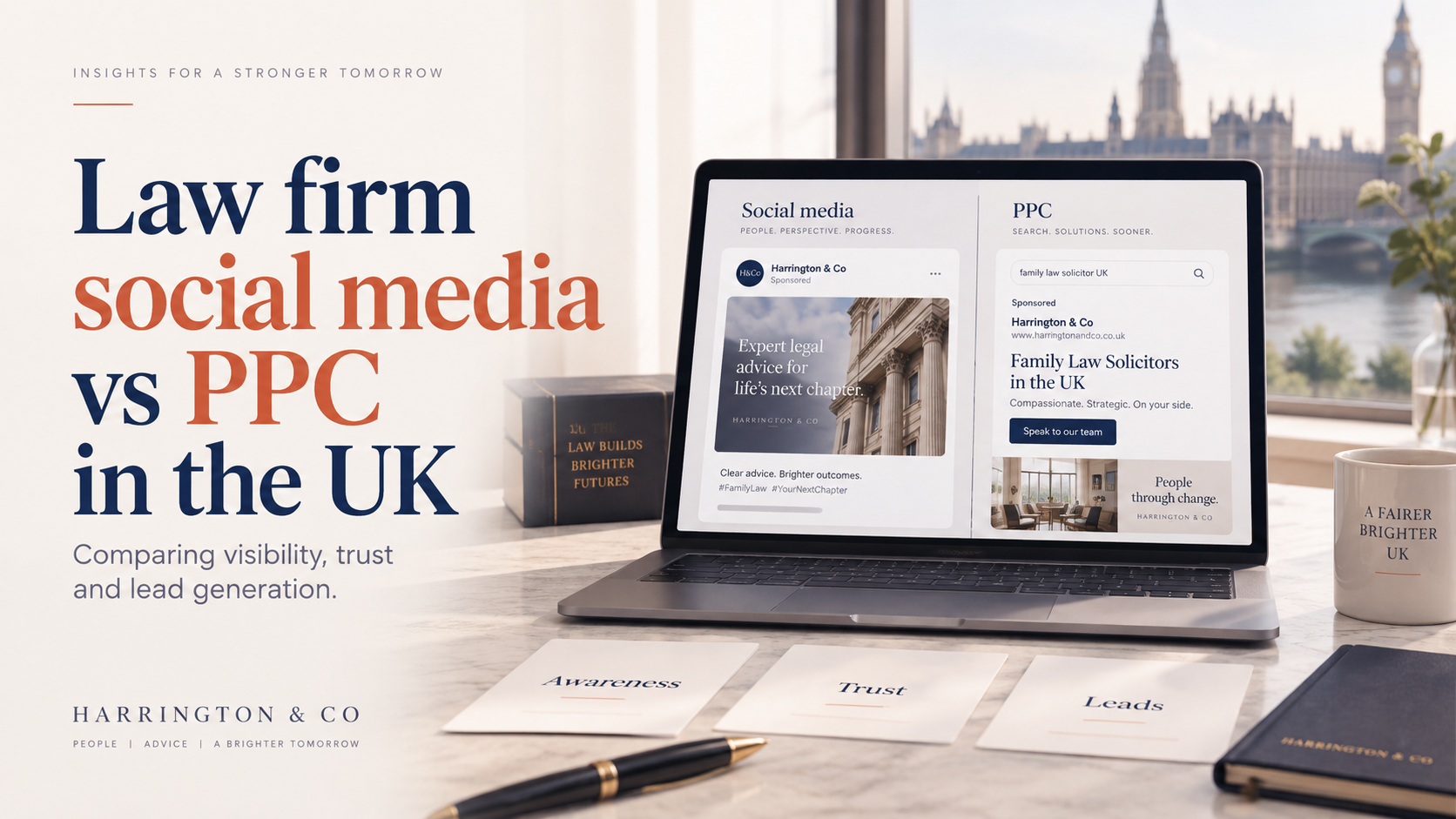
Small solicitors practices, niche specialists and start‑up firms often face the same question: should we spend our limited marketing budget on paid search/social ads or on organic social content? This guide to law firm social media vs ppc uk helps you choose by considering four practical factors — budget, timeframe, lead value and compliance risk — then offers clear 90‑day starter plans you can follow straight away.
At a glance: PPC ad creative vs organic social content for small law firms
One‑paragraph summary of PPC
PPC (pay‑per‑click) gets your firm in front of people actively searching or scrolling with targeted ads. It’s measurable and quick to test but costs money from day one, requires conversion‑focused landing pages and careful tracking, and carries advertising policy and professional conduct considerations.
One‑paragraph summary of organic social
Organic social content builds credibility and referral potential over time. It’s lower cost to publish but needs consistency and a content plan to grow reach. Organic is ideal for brand, recruitment and thought leadership, and it supports longer term SEO and client trust.
Quick comparison: speed, cost, control, measurability, credibility
- Speed: PPC = fast; Organic = slow to medium.
- Cost: PPC = direct media spend; Organic = mainly resource time or agency fees.
- Control: PPC = precise targeting; Organic = broader, audience builds via value and trust.
- Measurability: PPC = straightforward metrics (CPL, CTR); Organic = engagement, referral traffic and search lift.
- Credibility: Paid needs strong landing pages and social proof; organic builds credibility more naturally.
How to choose: the four questions every small law firm must ask
Question 1 — What is your primary goal?
If you need immediate, trackable enquiries for a specific service (for example conveyancing completion slots or funds‑planning consultations), PPC is usually the better fit. If your priority is reputation, referrals, or hiring trainees, organic social will often deliver more value.
Question 2 — How quickly do you need results?
PPC can deliver clicks and enquiries within days. Organic social typically needs weeks or months of consistent posting before reliably producing enquiries.
Question 3 — What budget and internal resource do you have?
For PPC you need budget for media plus someone to manage campaigns and landing pages. For organic you need time or an external creative resource to produce content and respond to engagement.
Question 4 — What regulatory or compliance constraints apply?
Check Solicitors Regulation Authority guidance and platform ad policies before running ads or posting advice online. Compliance can affect messaging and what claims you may make, so factor in review time and approval workflows.
When PPC is the better first investment
Typical use cases
- Time‑sensitive lead generation (limited offers, specific case types).
- High‑value, niche services where a small number of enquiries justify spend.
- Local intent searches (people actively searching for a solicitor in your area).
Required assets
- Conversion‑focused landing pages with clear contact steps — if you need better landing pages, consider a WordPress website consultation.
- Ad creative and short, compliant copy tailored to the platform.
- Tracking: UTMs, conversion tracking and a privacy‑compliant approach to consent.
How to structure a small‑budget PPC test
- Define one narrow offer (eg. ‘free 15‑minute telephone review for wills’).
- Build a single landing page and form, add clear tracking and a privacy note.
- Run small tests on Google Search and a single social channel, use focused keywords and device targeting.
- Allocate 4–6 weeks to gather meaningful data, then measure cost‑per‑lead and conversion rate before scaling.
When organic social should be your priority
Typical use cases
- Long‑term brand building, referral and community engagement.
- Specialist firms relying on trust and reputation or those wanting to recruit.
- Firms with limited media budgets but time to commit to consistent content.
Content types that perform for solicitors
- Short thought leadership posts explaining common client questions.
- Case studies or anonymised outcomes (observe confidentiality rules).
- Team profiles and day‑in‑the‑life posts to humanise your practice.
- Explainers and checklists that encourage shares and save behaviour.
For ongoing management and structure, see our practical guide to Social Media Management for Law Firms: A Practical UK Guide.
Follow accessibility best practice for images and captions — our Accessible social media graphics guide explains simple steps to make posts inclusive.
If you need a coherent visual identity to support organic credibility, consider discussing a complete brand identity with Logo Metic: Discuss a complete brand identity.
Practical posting cadence and repurposing advice
- Start with 2–3 posts per week and repurpose long posts into shorter updates, carousels and short video clips.
- Create templates to speed production — our Social media templates for law firms UK can help you publish compliant, professional posts quickly.
- Engage with comments promptly; social referral traffic grows when you build relationships.
Measuring ROI: KPIs, tracking and realistic expectations
Key PPC KPIs
- Cost‑per‑lead (CPL).
- Click‑through rate (CTR).
- Landing page conversion rate.
Key organic KPIs
- Reach and follower growth.
- Engagement rate (likes, comments, shares).
- Referral traffic and branded search lift on your website.
Simple tracking checklist
- Use UTMs on all campaign links.
- Set up Google Analytics goals or GA4 conversions for form submissions.
- Enable basic conversion tracking for Google and Meta ads where used.
- Document baseline figures for comparison before you start.
- If you need conversion‑focused pages or forms, consider a WordPress website consultation; conversion‑first design principles also apply from our e‑commerce design experience.
90‑day starter plans: two practical roadmaps (PPC‑first and Organic‑first)
PPC‑first 90‑day plan (setup, test campaigns, refine creative, scale)
- Week 1–2: Define offer, create one landing page, set up tracking and privacy notices.
- Week 3–6: Launch small tests on Google Search and one social channel; monitor CPL and conversions.
- Week 7–10: Refine keywords, creative and landing page copy based on data.
- Week 11–12: Scale the best performing campaigns modestly and continue to report weekly.
Organic‑first 90‑day plan (content calendar, templates, amplification)
- Week 1: Audit existing profiles, choose priorities and setup a simple 3‑month content calendar.
- Week 2–6: Produce core assets (team profiles, 6 educational posts, 3 short videos) and build templates; see Social media templates for law firms UK.
- Week 7–10: Publish consistently, track engagement and repurpose high‑performing content.
- Week 11–12: Review metrics, test one paid boost for top content to increase reach.
Resource checklist: who does what (in‑house vs freelancer vs agency)
- In‑house: day‑to‑day posting, client responses, local knowledge.
- Freelancer: content creation, ad management, one‑off projects.
- Agency: strategic planning, combined paid/organic execution and reporting.
- If you’re unsure whether to hire, our decision guide helps: Should a Small Business Hire a Social Media Manager?
- For pricing and engagement models see: Social media content design pricing models UK.
Compliance, risk and professional standards for UK solicitors
Common compliance pitfalls for social and ads
- Mistakenly making client outcome promises or using identifiable client information without consent.
- Failing to include required regulatory information or misleading claims in ads.
- Inadequate record keeping of advertising approvals and revisions.
Simple controls to reduce risk
- Use an approvals workflow with documented sign‑off for all public copy.
- Add short disclaimers where appropriate and avoid absolute promises.
- Keep templates for compliant posts and ads to speed review.
When to get legal or professional‑advice sign‑off
For novel claims, sensitive practice areas or high spend campaigns, ask your compliance officer or seek professional guidance before publishing.
When to hire an agency and how to brief them
Signs you’re ready to hire
- You lack capacity to produce consistent content or manage ad optimisation.
- Campaign complexity or media spend requires specialist skills.
- You want an integrated paid and organic strategy with reporting.
What to include in a brief
State your objectives, target services, expected monthly budget, required deliverables (ads, landing pages, creative, reporting cadence) and compliance constraints. For a practical brief template, see How to brief an agency for a social media creative retainer.
Questions to ask prospective suppliers and a red‑flag checklist
- Ask for examples of work in professional services and how they handle compliance approvals.
- Red flags: no clear reporting, vague deliverables, pressure to promise results.
Checklist & quick decision matrix
- Choose PPC if you need leads quickly, have a conversion‑focused page and a small test budget.
- Choose organic if you need long‑term credibility, referrals or recruitment and can commit time to content.
- Test and measure: run a short PPC test while building an organic plan where possible.
FAQ
Should my small law firm prioritise PPC ads or organic social content first?
Prioritise PPC for immediate, measurable lead generation; prioritise organic social for brand, referrals and recruitment. If possible, run a small PPC test while you build your organic content pipeline.
How long will it take to see results from PPC compared with organic social?
PPC can produce clicks and leads within days. Organic social typically takes weeks to months to build steady referral traffic and enquiries.
What minimum budget and resources are realistic for a small solicitors practice?
Budget depends on geography and service. Factor in media spend, creative production and management time. Refer to our pricing models guide for common engagement types: Social media content design pricing models UK.
Are there special compliance rules for solicitors when advertising on social media or running PPC?
Yes. You must follow SRA guidance and platform ad policies. Use a review process and get professional sign‑off for sensitive claims.
When is it worth hiring an agency rather than doing social or PPC in‑house?
Hire when you lack time, need specialised skills or want integrated paid and organic strategy. Use the brief guidance above and our briefing template: How to brief an agency for a social media creative retainer.
Conclusion and recommended next actions
Small law firms should choose based on goal, speed, budget and compliance. If you need leads fast and can support conversion tracking, test PPC first. If you need to build trust, referrals or hire, start with organic social. Where possible, run a short PPC pilot while you build organic assets.
If you want help implementing either approach, request a free consultation with Logo Metic to discuss a tailored PPC or organic social starter plan for your firm: support@logometic.co.uk / +44 7883 180004. For visual identity or landing page work, consider a custom logo consultation or a WordPress website consultation to ensure your ads and posts lead to a strong, conversion‑ready experience.
Please note: check SRA and platform policies for the latest requirements and seek professional advice on regulatory matters where needed.