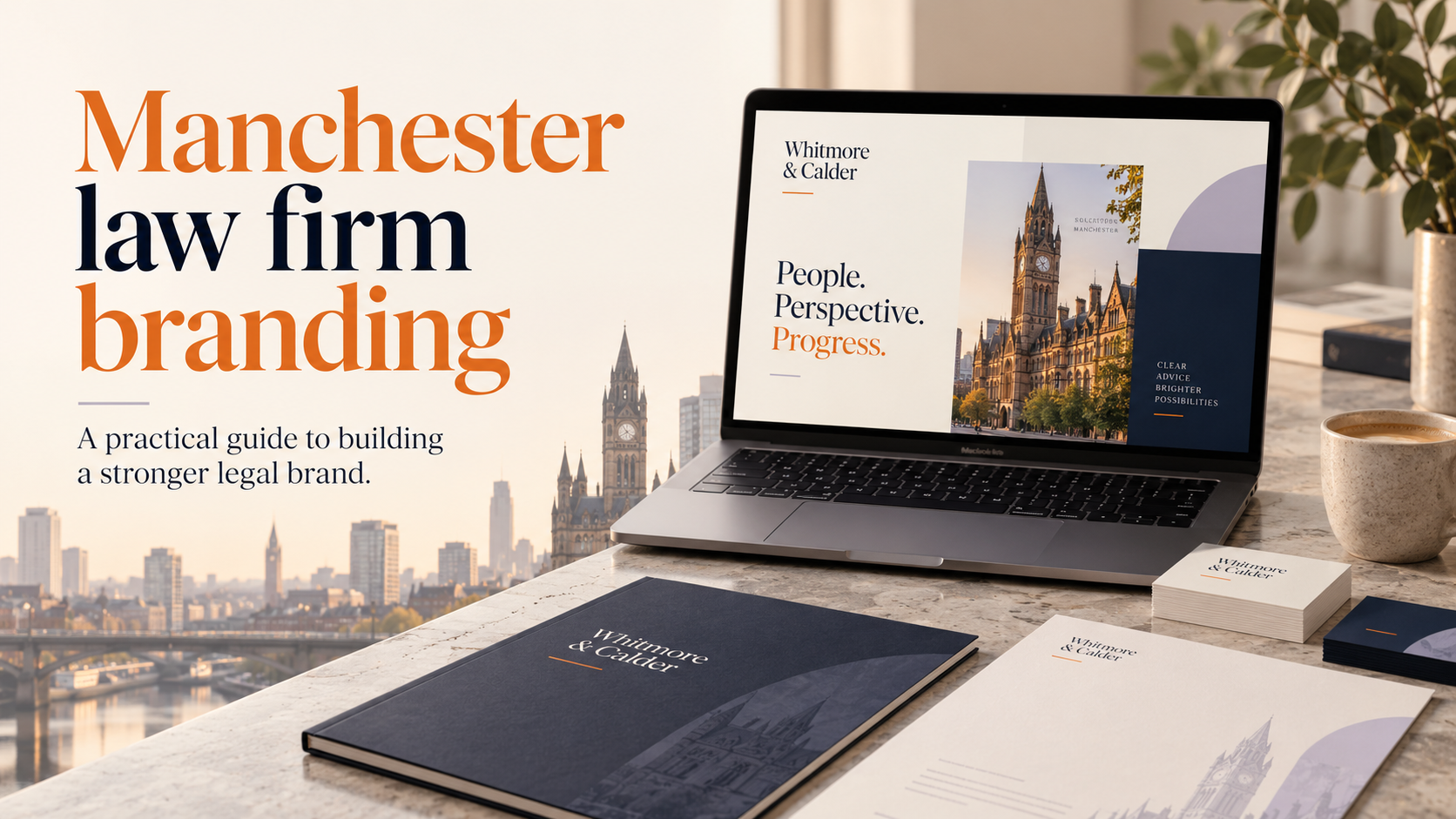
Why branding matters for Manchester solicitors
Manchester is a competitive legal market. Strong, localised manchester law firm branding helps solicitors build trust, attract the right enquiries and justify fee levels. A clear brand reduces friction in the first meeting and makes marketing — online and offline — more effective.
Local market context: Manchester’s legal sector and client expectations
Clients in Manchester expect professionalism but also clarity and local relevance. From SMEs in the Northern Quarter to residents in Didsbury, different audiences respond to different visual cues. Showing local knowledge through visuals and messaging improves relevance and lead quality.
How brand perception affects enquiries, conversions and fee structure
A confident, coherent brand helps triage enquiries before the first conversation. When your website, social posts and stationery present a consistent identity, prospective clients perceive reliability and are more likely to accept advisory fees or retain services quickly.
Manchester law firm branding: Visual trends for 2025
Below are practical visual directions that work for solicitors, with notes on adapting each to Manchester audiences.
Contemporary professional palettes and typography: trusted, yet not generic
Move beyond pure navy-and-gold clichés by selecting a primary trusted tone (deep blue, charcoal or forest green) paired with a unique secondary colour that reflects your firm’s character — for example, a warm terracotta for community-focused practices or a cooler teal for commercial teams. Choose typefaces with strong legibility on screen and in print; pair a neutral, readable serif or humanist sans for headings with a clear sans for body text.
Photography, imagery and local cues: using Manchester scenes and team shots without cliché
Use real team photos and local imagery, but avoid overused landmarks as the only signal. Shots of your office exterior, team working in meeting rooms, or unobtrusive views of nearby streets (Granary Wharf, Ancoats canals, local parks) add locality without resorting to stocky Manchester skyline montages. For practical guidance on hero images and team photos, see our article on essential visuals for B2B service pages which covers consistent treatments and crops.
Logo approaches: wordmarks, monograms and emblem variations for solicitors
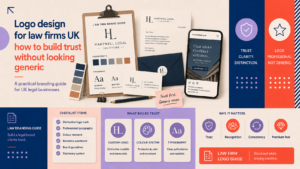
Many modern firms favour flexible wordmarks with a confident, simple logotype and a compact monogram for avatars and favicons. Emblems remain appropriate for practices with a long heritage, but keep them simplified for digital clarity. Provide horizontal and stacked variations plus a single-colour reversible mark for use on coloured backgrounds.
Accessible and trust-building visual details: contrast, legibility and iconography
Prioritise contrast and readable sizes for body text and buttons. Use straightforward iconography for services (conveyancing, employment, dispute resolution) and ensure icons follow a consistent stroke and scale. These details improve usability for older clients and meet accessibility basics.
Practical 8-step branding checklist for Manchester law firms
Follow this sequence. Each step includes practical tasks and low-cost options.
-
Step 1: Conduct a quick brand audit
Gather existing assets (logo files, letterheads, website screenshots, social accounts). Note inconsistencies in colour, typography and tone. Check three nearest competitors to identify common visual patterns and obvious gaps.
-
Step 2: Define your local positioning and target client profiles
Write short client personas (e.g. “Manchester SME owner — requiring commercial contracts”) and list what matters to each: speed, local presence, fixed fees. This informs imagery, tone and service page order.
-
Step 3: Create core messages and the single-sentence value proposition
Draft a one-line proposition for your homepage and use it consistently: who you help, what you do and one local differentiator. Keep four supporting bullets for service pages.
-
Step 4: Logo and identity: brief, options and minimum deliverables
Prepare a short brief listing required logo variations, colour palette, and file formats (SVG, PNG transparent, mono versions). If you need professional help for a solicitor-appropriate logo, consider a custom logo design service to ensure files and guidance are delivered to a usable standard.
-
Step 5: Website and UX: priorities for service pages and contact journeys
Prioritise a clear homepage proposition, dedicated service pages with claims that comply with regulations, and a simple contact/booking flow. If you plan a redesign on WordPress, our WordPress web design service can build conversion-focused templates and ensure consistent styling across pages. For homepage messaging guidance specific to solicitors, our messaging framework article is a useful companion.
-
Step 6: Social, paid ads and local listings: consistent visuals and templates
Create social templates and a short creative brief for paid social. Keep imagery consistent with website hero crops and team shots. For paid creative that meets solicitor compliance, review our practical checklist for law firm social ads.
-
Step 7: Offline touchpoints: signage, stationery and local PR
Apply the same colour, logo and typography rules to signs, business cards and letterheads. Use local PR — e.g. comment on Manchester business stories — to build visibility and local trust.
-
Step 8: Measure, gather feedback and iterate
Track enquiry sources, message tests on the homepage and simple user feedback after initial calls. Iterate visuals and copy based on what increases qualified enquiries.
Design resourcing: in-house, freelance or agency?
Pros and cons: in-house vs freelance vs design agency
In-house gives control and fast turnarounds but may lack breadth of creative experience. Freelancers are cost-effective for single tasks but can be inconsistent. Agencies offer wider teams and quality assurance, useful where compliance and multi-channel rollout matter.
How to brief a designer or agency: must-have elements and compliance notes
Include your positioning, client profiles, required deliverables, accessibility expectations and any SRA guidance that affects claims or imagery. Ask about deliverable formats and ownership of source files.
Checklist for evaluating partners (portfolio, process, local experience)
- Review portfolio for professional services work.
- Ask about experience with solicitor or regulated sectors.
- Check process: research, concepts, revisions and handover.
Local examples and quick visual wins to implement this month
Small changes can make a big difference fast.
- Update hero images and team photos — consistent crops and a common colour grade make your site feel more professional.
- Standardise fonts and colours — set up simple CSS rules or document fonts in a single brand sheet.
- Create a simple brand asset pack — include logo files, colour codes and image rules. If you want ready-made social templates to start quickly, see our social media templates for law firms.
- Local trust signals — add neighbourhood pages, team bios with Manchester location notes and links to local organisations.
social media templates for law firms UK: compliant, professional post designs for solicitors
For practical WordPress advice in Manchester, our local guide explains priorities for small businesses planning a site refresh.
WordPress web design in Manchester: a practical guide for small businesses
Implementation roadmap and budget-aware options
Phase 1 (1 month): Quick wins
- Brand audit, homepage wording tweak and better hero crop.
- Update contact flows and standardise email signatures.
Phase 2 (3 months): Core identity
- Commission a logo and visual system, produce new service page templates. If you need a full identity, consider a brand identity design project to cover guidelines and assets.
Phase 3 (6 months): Scale
- Website rebuild, paid creative and content programme. For transaction-capable services or selling guides, our e-commerce store design capability can support online payments and downloads.
Low-cost alternatives and what to avoid
Use high-quality stock sparingly and avoid quick logo redesigns without basic testing — inconsistent rollouts cause more harm than a conservative refresh.
Compliance, ethics and accessibility for solicitors’ branding
Advertising and marketing rules relevant to solicitors
Follow Solicitors Regulation Authority guidance on advertising and marketing when making claims. Be cautious with statements about outcomes and avoid presenting speculative results as guarantees. Seek legal advice if you’re unsure about specific claims.
Client confidentiality and imagery consent
Obtain written consent before using client images or case-related visuals. When showing team photos, confirm permission for website and social use in writing.
Accessibility basics (contrast, readable type and mobile-friendly layouts)
Ensure sufficient contrast, legible font sizes and mobile-responsive layouts. These measures help older clients and meet basic WCAG expectations.
FAQ
How much time does a Manchester law firm rebrand usually take?
Timelines vary: a basic refresh (audit, colours, templates) can be done in 4–6 weeks; a full identity and website rebuild typically takes 8–16 weeks depending on approvals and content readiness.
Will changing our logo or colours harm our search rankings or confuse existing clients?
Changing visual identity alone does not directly harm search rankings if URLs and content remain stable. Communicate the change to clients and preserve contact pages and important URLs to avoid confusion.
What visual elements help solicitors build trust with local Manchester clients?
Clear team bios with local credentials, real office imagery, consistent colours and legible type all increase trust. Local mentions and neighbourhood pages also help demonstrate relevance.
Do solicitors need to follow special advertising or compliance rules when updating branding?
Yes. Branding and marketing must comply with SRA advertising rules. Avoid unverified outcome claims and ensure imagery does not imply confidential client situations without consent.
What are low-cost branding improvements a small Manchester firm can implement this month?
Standardise phone and email signatures, update hero images and team photos with a single treatment, create a one-page brand sheet and publish clearer service pages with local cues.
Next steps and how to get help
Short action checklist to start today: perform the quick brand audit, write a one-line value proposition, update your homepage hero and gather team photo permissions.
When you need professional help, ask for deliverables, accessibility checks and evidence of experience with professional services in your brief. If you’d like to discuss a project, request a free consultation with Logo Metic to review your brief and next steps.
Request a free consultation with Logo Metic — email support@logometic.co.uk or call +44 7883 180004 to discuss branding, identity or website projects.